
By Adam Pagnucco.
In this year’s MoCo Democratic primary, public campaign financing was heavily used by county candidates. However, that did not reduce the influence of outside groups, who collectively spent nearly $3.4 million supporting and opposing candidates for county executive, county council, sheriff and school board. This series examines the activities of these groups along with the candidates they helped and hindered.
Two 2010 federal court decisions – Citizens United v. FEC, 558 U.S. 310 (2010) and Speechnow.org v. FEC, No. 08-5223 (D.C. Cir. 2010) – led to the legalization of independent expenditure-only political action committees, commonly known as Super PACs. These entities may raise and spend unlimited amounts of money to support or oppose candidates, but they are prohibited by federal and state law from coordinating with candidates. While they must disclose their contributors, some of those contributors (particularly 501(c)(4) nonprofits) do not have to disclose their contributors, thereby hiding the ultimate source of contributions. This phenomenon, while not found in all Super PACs, has given rise to the term “dark money.”
The State Board of Elections (SBE) requires Super PACs and independent expenditure (IE) entities to register and file campaign finance reports. In addition to regularly scheduled reports, these entities must file reports within 48 hours of making $10,000 or more in independent expenditures. These reports not only state amounts spent, they also list category and purpose of expenditures as well as candidates they support or oppose. Compiling these reports enables analysis of who is spending, who is benefiting and who is being targeted by negative campaigning.
However, these reports do not capture all independent activity in elections. Neither the activities of regular PACs (which long predate Super PACs) nor volunteer activities are included. That matters a lot, since regular PACs often run mail and digital campaigns and the Apple Ballot, relying on volunteers for distribution, is the county’s most influential endorsement. Another important factor this cycle was the canvassing of local democratic socialists, which benefited their endorsed candidates.
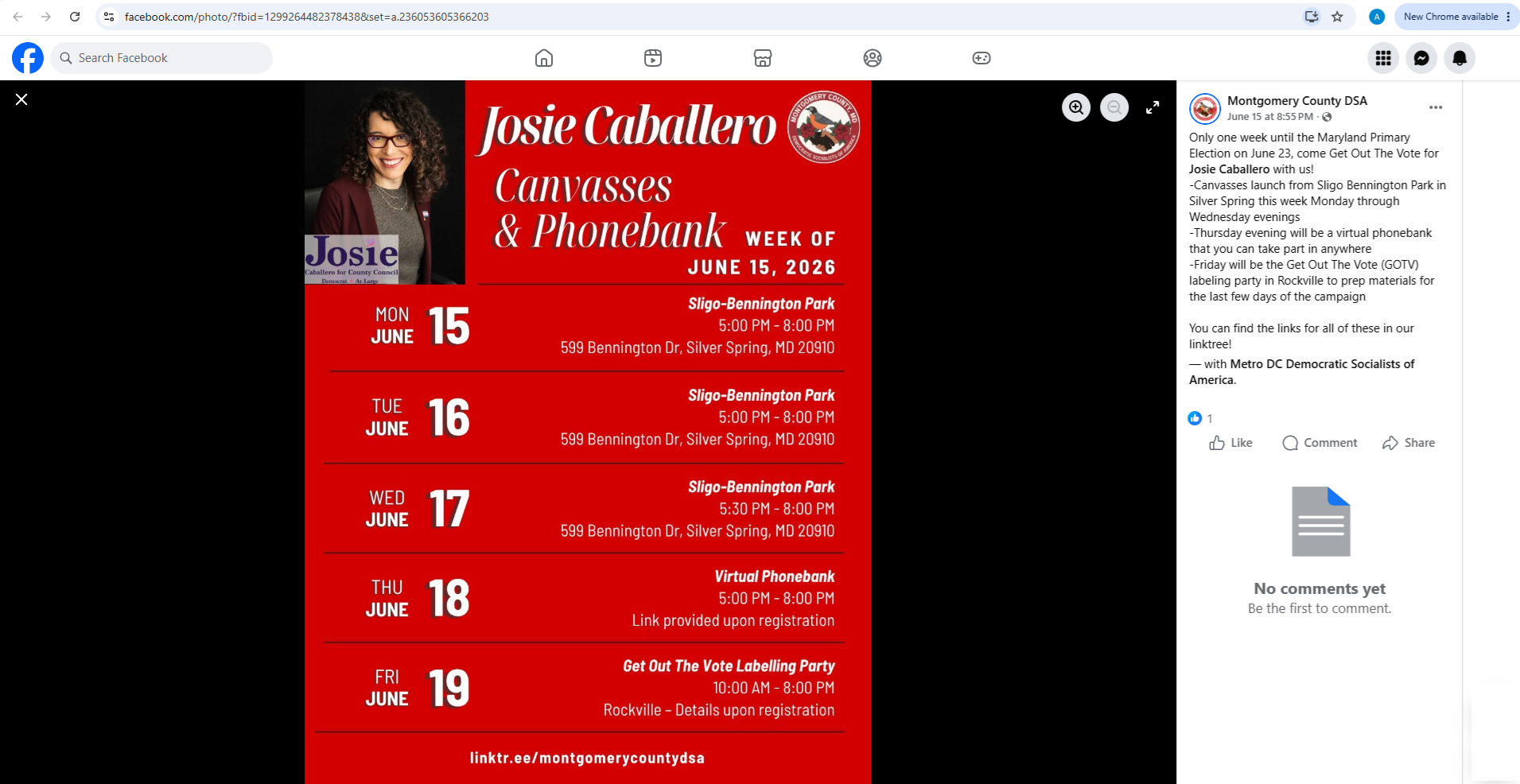
MoCo democratic socialists canvassed frequently for council at-large candidate Josie Caballero.
With the above caveats in mind, I was able to identify eight IEs and Super PACs who spent on MoCo county-level elections. We will reveal them next.