
By Adam Pagnucco.
This year’s county operating budget produced an excruciating double-digit tax hike on most homeowners as well as a structural deficit for next year. Now, the county’s most recent six-year fiscal plan lays out a possibility that few residents welcome: there could be yet another tax increase on the way.
First, some context. Every spring, the county executive recommends and the county council approves an operating budget. While these budgets are annual, the county also produces six-year fiscal plans to forecast what lies ahead. The latest plan, applying to the years FY27-32, is a grim read.
Let’s start with revenue projections as shown in the table below. In FY27, revenues are projected to rise by 3.9% thanks to the council’s decision to abolish the $692 Income Tax Offset Credit (ITOC) received by most homeowners. Afterwards, revenues are supposed to rise by 2.0-2.3% per year, which is lower than the average rate of local price inflation since 2021 (3.8%). Long-term stagnation in the county’s economy is a major cause of slow growth in county revenues.
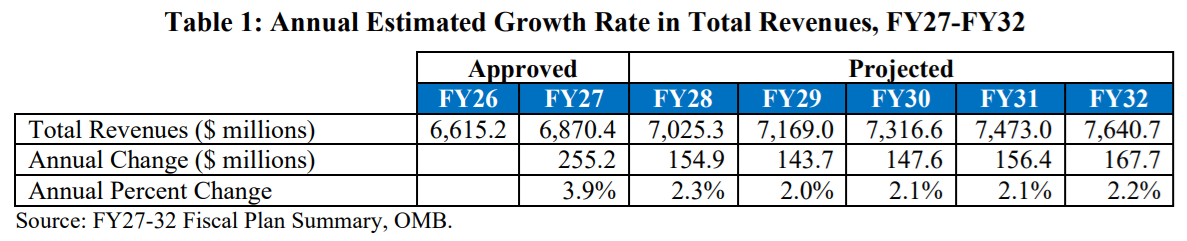
Sluggish revenue growth is a major challenge.
The fiscal plan organizes spending into two areas. The first is non-agency commitments including debt service (a mandatory expenditure), cash for the capital budget, reserves (which are supposed to be 10% of revenues) and money set aside for retiree healthcare. Once these non-agency commitments are subtracted from revenues, the remaining funds are available for spending in agency operating budgets. The county’s four largest agencies are county government, MCPS, Montgomery College and Park and Planning.
Money available for agencies typically rises in successive fiscal plans. However, that’s not projected to happen in the next fiscal year (FY28). Council staff comments, “The growth rate [in money available for agencies] from FY27 to FY28 is estimated to decline by 2.1%. This decline is due to the growth in current revenue in the CIP and reduced use of reserves in FY28. In total, these two factors are reducing available resources in FY28 by $296.0 million.” The combination of slow revenue growth, more cash required for the capital budget and less reliance on one-time money from reserves is a reduction in money available for agencies of $134.4 million in FY28 as shown in the table below.
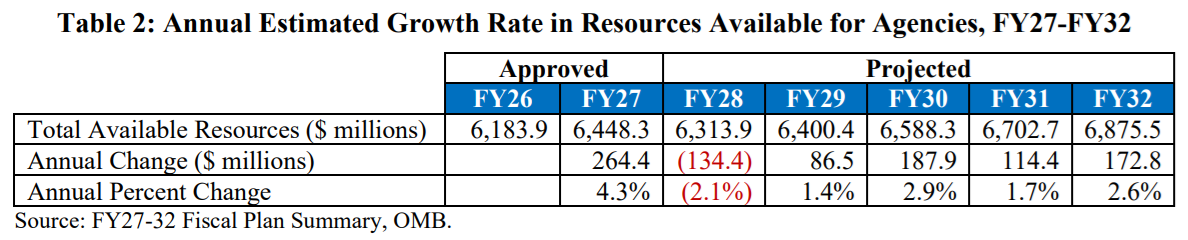
See how that $134.4 million is shown in red? The reason is that it’s a cut.
Let’s put this in perspective. Despite a huge tax increase on most homeowners, county agencies are due for an absolute combined cut next year. We’re not talking about a reduced rate of spending, but less dollars period. That’s what happens when you have a stagnant economy, minimal revenue growth, over-reliance on one-time budget band-aids (more on that below) and a structural deficit.
So how does the county get out of this jam? First, let’s quantify it. Over the last decade, county agencies received average annual operating budget increases of 4%. If we apply that percentage to current agency spending ($6.448 billion), that would mean an increase of $258 million. Since the currently projected cut is $134 million, county leaders would have to find $392 million to get the agencies on a normal budgetary footing.
That’s a ton of money. Consider that the hugely unpopular homeowner tax hike raised a gross total of just $140 million.
So how can county leaders find that much money?
The first thing they will do is go back into the one-time bag of tricks they have used before: diverting retiree healthcare money (usually tens of millions), using one-time money from reserves (the executive planned to use $191 million of that last spring) and grabbing cash from the capital budget (which is projected to need $226 million next year). But those “solutions” have problems. Credit rating agencies dislike use of retiree healthcare money and reserves for ongoing spending and the county has a multi-billion dollar infrastructure maintenance backlog that will only get worse if capital funding is reduced. There is a limit to these types of band-aids.
They could get serious about spending. Given what happened last spring, that seems unlikely since the council’s grand total approved operating budget trimmed just 1% of spending from the executive’s recommended budget. Tweaks of this kind are insufficient to deal with the county’s fiscal problems.
That leaves one more place to go.
Taxes.
There are three options that could raise real money. First, raise income taxes on people making less than $150,000 a year. (People above that level are already paying the maximum rate allowed by state law.) Second, raise property tax rates. Or third, raise energy taxes even though MoCo already has by far the highest energy taxes in the region.
It seems wild that these are the choices, but they are. This is the legacy of nearly twenty years of economic stagnation. If another tax increase is levied, how many more years of such stagnation will follow? And then what future tax increases await?