
By Adam Pagnucco.
It’s the question being asked throughout MCPS’s vast stakeholder community: which schools will close? That question is top of mind because of MCPS’s current process to consider elementary and middle school closures, which is due to conclude with a school board vote in April. That vote will be followed by another process to redraw elementary and middle school boundaries to reflect any closures.
What got us to this point? That’s a story for a future post, but here is the short version. MCPS had near-continuous enrollment growth from 1984 through 2020. That growth was accompanied by a huge school construction boom that expanded and modernized dozens of schools and built several other new ones. At the time, that seemed necessary, but it did expand MCPS’s facility needs and funding has not kept up. Now MCPS’s enrollment is declining and it has more than 30 schools that are projected to be less than 70% full by the 2032-33 school year.
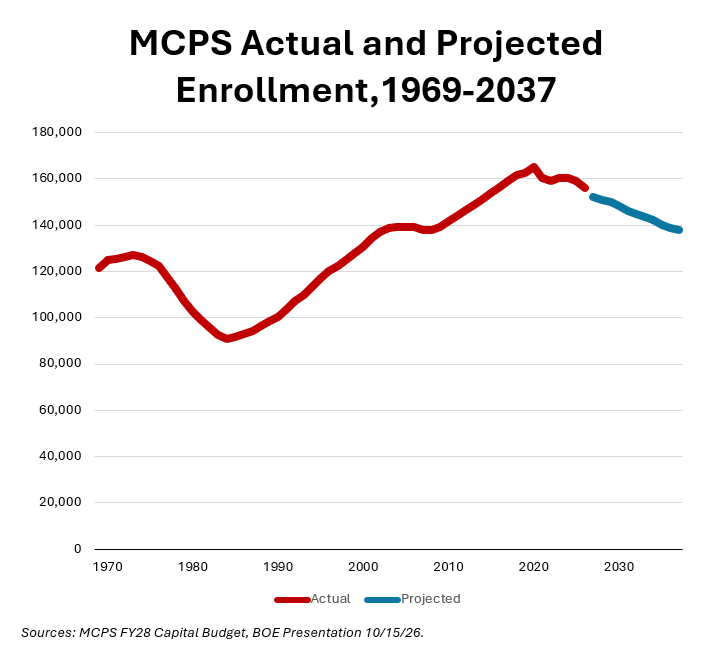
MCPS’s declining enrollment is the reason the district is looking at closing schools.
With so many underutilized schools and tight funding, it’s understandable that MCPS would undertake a closure and consolidation process. Which schools are most vulnerable to closure? Let me emphasize: I have no inside information on this. If I were to ask MCPS, I am 100 percent sure they would direct me to their public presentation and say, “No decisions have been made at this time.” And that would be the appropriate and correct answer.
But I can read data just like you and thousands of folks in the MCPS community. And it tells a story: some schools are more likely to be considered for closure than others. And why? Toss out the conspiracy theories and embrace the math, folks. If I were MCPS’s consultant (and I’m not!), I would start with a preliminary framework for identifying closure and/or consolidation candidates. These three factors would play an important role in my analysis.
Projected capacity utilization
The FY28 MCPS recommended capital budget contains capacity utilization rates for every school projected out to the 2032-33 school year. This is obviously important because less utilized schools would presumably be considered for closure/consolidation more than heavily utilized ones. However, this factor is insufficient on its own. Imagine a half empty school adjacent to a crowded one. In that circumstance, redrawing the boundary lines and sending students from the crowded school to the less used one might be a better option than closure. So a second related factor is needed.
Projected capacity utilization at neighboring schools
Let’s imagine a school at severe undercapacity – say, less than 60%. What if such a school were next to other underutilized schools? Then closure/consolidation might make some sense because nearby schools would be able to absorb students from a closed one. And so, we need to look at groups of schools, not just individual ones.
Facility condition
MCPS has huge, unfunded capital and maintenance needs. Those needs significantly vary between new schools that are in superior condition and much older ones that are crumbling. MCPS measures the condition of its buildings with its facility condition index, which is publicly released along with reports on each building. It makes little sense to close new schools in great shape; let them absorb students through consolidations and/or redistricting instead. Older schools in poor condition that are underutilized require big capital investments to continue operating. They are more logical candidates for closure in the event that closure is warranted.
If I were undertaking this work, I would use this framework to identify groups of schools for further analysis. Then I would apply other factors cited by MCPS to whittle them down. Any consultant not using a rational, numbers-based framework of some kind would be quickly swamped by MCPS’s complexity and the substantial grassroots capacity of its stakeholders. This is MoCo, and in our county, people FIGHT for their schools.
As it turns out, there are several groups of elementary schools that contain multiple underutilized schools and, in most cases, at least one school ranking average or worse on MCPS’s facility condition index. At a minimum, any consultant worth their salt is going to take an interest in these groups.
Finally, closure might not be the best outcome in some of these cases. Often, I wonder whether redrawing boundary lines might be a better way to resolve utilization issues between nearby schools.
We will start naming these groups of schools next.