
By Adam Pagnucco.
On Friday, I reported that the county council adopted progressive income tax brackets and abolished the Income Tax Offset Credit (ITOC), a $692 tax credit received by more than 192,000 homeowners, to pay for it. The net effect was a tax increase on homeowners currently receiving the tax credit with some of the highest amounts charged to low income homeowners. The council had previously voted to reject County Executive Marc Elrich’s recommended 6.3 cent property tax increase, essentially substituting its own smaller tax increase for the executive’s.
Now Elrich has come out swinging against the council’s plan, criticizing it on WAMU’s Politics Hour and picking it apart in his Friday message to constituents. While Elrich’s methodology is different than mine, he confirms one of my central findings: among homeowners, the council’s tax increase hits lower income folks more than most. I have many differences with the county executive on tax policy, but his take on this is worth a read. Pay particular attention to the table he uses on assessed valuations to reach his conclusions on differential impact by income levels.
Let’s turn it over to Elrich.
*****
FY27 Budget Deliberations Update – The County Council’s Tax Increase Proposal
I want to begin by thanking the County Council for its unanimous decision to fully fund the contracts my administration negotiated with our employee groups. I am very pleased that all 11 members agreed that our dedicated County employees deserve a pay increase in line with the rising cost of living in our region.
As you know, the budget I submitted in March also included a property tax increase dedicated solely to our school system. I knew this was a lot to ask of our residents, but my 70 years in this community (as a student, parent, grandparent, teacher, elected official, and taxpayer) have taught me that this community values education and is willing to pay more to give our children the best opportunity for a great life.
Earlier this week, the County Council voted to set aside my proposed broad-based property tax rate increase that would have raised the rate on all properties by 6.3 cents. Instead, on Friday, the Council voted to eliminate the County’s largest property tax credit for homeowners — the Income Tax Offset Credit (ITOC) — which provides every homeowner with a $692 reduction in their property tax bill. My property tax proposal was estimated to bring in $135 million in additional revenues just for our schools. The Council’s tax proposal brings in $139 million more for general purposes.
While some may characterize this action as a rejection of all of my tax increases, they are simply proposing a different type of tax increase: one I fear is far more regressive.
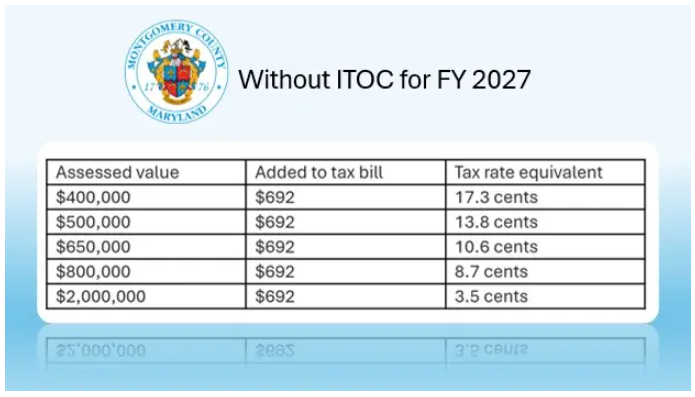
As you can see on the chart above, this move to eliminate the ITOC hits different homeowners in an unequal and unfair manner. And, it allows commercial properties like shopping centers and office buildings to escape with no increase in their bills.
As illustrated in the chart, with the ITOC being eliminated, every homeowner’s tax bill will increase by $692. If the home is assessed at $650,000 (which is the average value of a home in the County), that homeowner will pay the equivalent of a 10.6 cent tax increase. If the home is assessed at $800,000, that homeowner will pay the equivalent of an 8.7 cent tax increase. If the home is assessed at $2 million, that homeowner will only receive the equivalent of a 3.5 cent tax increase.
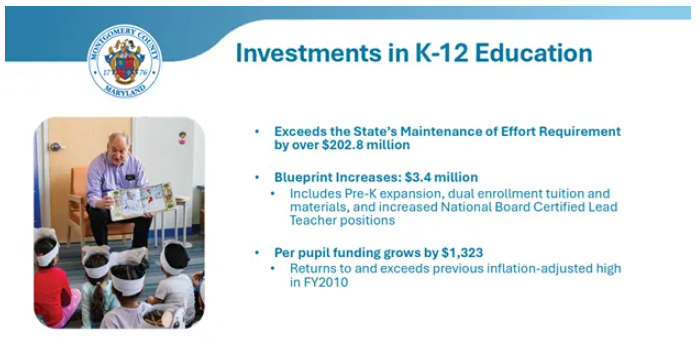
Once again, I proposed a 6.3-cent property tax increase solely dedicated to MCPS funding, while preserving the ITOC. For the 88% of County homeowners with properties valued at less than $1.09 million, the cost of eliminating the ITOC exceeds the tax increase I recommended. Again, while some are characterizing the Council’s action as avoiding a tax increase, for the vast majority of homeowners, it amounts to a larger bill.
And I cannot stress this enough – the Council’s action only raises taxes on homeowners. Commercial properties are untouched under the Council plan — homeowners absorb the entire cost. I should not be surprised. This is the same Council that has had no problem passing million-dollar tax breaks for developers and lowering the property tax burden on some developers per the 2024-2028 Growth and Infrastructure policy. And since Maryland corporations don’t pay a County income tax, there is no offsetting corporate revenue to the County. For several years, legislation in Annapolis would have allowed us to create a separate commercial property tax rate to fund infrastructure — but it has not passed. I suggested a new idea to differentiate our commercial and property taxes, but it does not appear to have support from the County Council.
To make our fiscal matters worse, a second tax proposal was passed to restructure the local income tax. The Council plan would reduce income taxes for all taxpayers earning under $600,000, but this tax cut will not offset the property tax increase for any homeowner in the county.
Just as the Council rejected the Council President’s initial call to reduce employee compensation, councilmembers should reject this income tax plan. Let’s set aside the fact that the plan will only receive its first public hearing on Tuesday; the focus right now should be on meeting as many of the MCPS’ requests as possible.
I respect the desire many on the Council have to provide relief to struggling families. That is why I included an increase in our Working Families Income Supplement (WFIS), a program that puts meaningful dollars into the pockets of working parents with dependent children for food and housing. It is more targeted than an income tax cut, because larger families get more under the WFIS, and I urge those who share my goal of helping the most vulnerable to return to this proposal because, as it stands, we are in a lose-lose situation. The homeowner pays more, and the County collects less revenue overall.