
By Adam Pagnucco.
For the second time, County Executive Marc Elrich has vetoed the council’s appointment of James Hedrick to the planning board. Elrich told the press that he was going to do this and I have obtained his veto message to the council. Back in 2023, the council unanimously overrode Elrich’s veto of Hedrick and I don’t imagine a different outcome this time.
In his veto message, Elrich went into considerable detail on his objections to Hedrick. But the dispute between the two goes back before Hedrick was originally appointed to the board three years ago. As I printed in March 2023, Hedrick blasted Elrich on social media one day before the 2022 primary (when Elrich was facing a challenge from David Blair). Regardless of the merits of their opposing views, Elrich’s unhappiness with Hedrick is predictable. Also, the executive has a long memory.
Hedrick’s 2022 tweets are printed below along with Elrich’s veto message to the council. I have asked Hedrick if he would like to respond to Elrich’s statement, and if he does, I will print it.
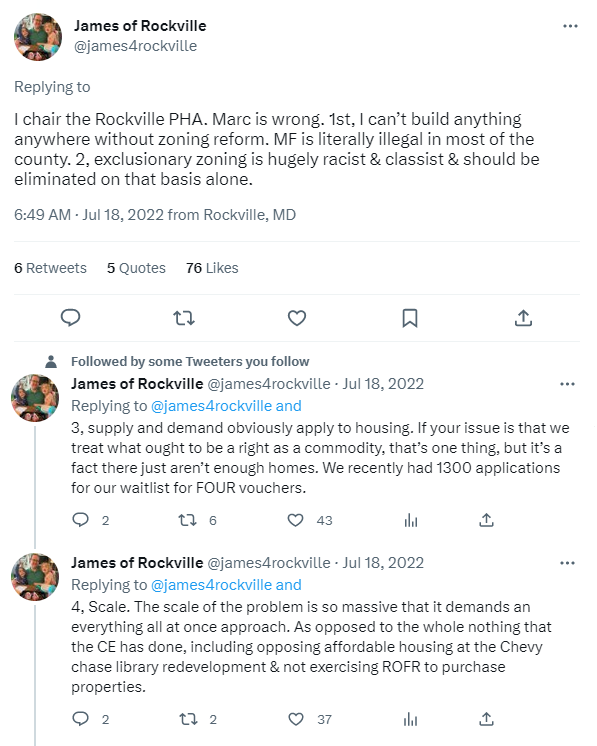
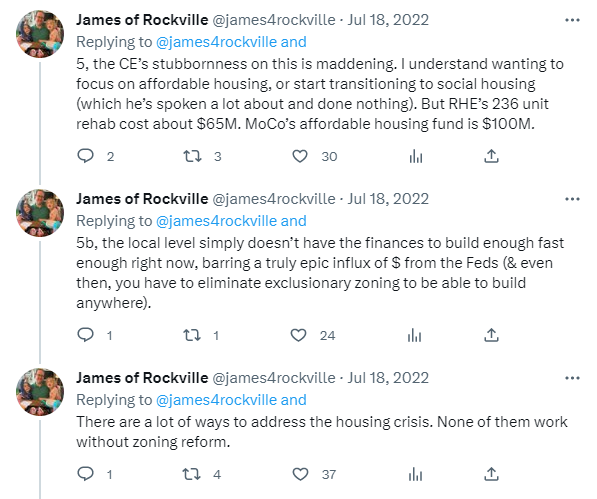
Hedrick’s 2002 tweets.
Elrich’s veto message follows.
*****
MEMORANDUM
August 27, 2026
TO: Natali Fani-González, President
Montgomery County Council
FROM: Marc Elrich, County Executive
SUBJECT: Disapproval of the Appointment of Mr. James Hedrick to the Montgomery County Planning Board
Section 15-103 of the Land Use Article of the Maryland Code provides for the County Executive to approve or disapprove appointments of commissioners to the Maryland-National Capital Park and Planning Commission. On Friday, July 31, 2026, the Council submitted the appointment of James Hedrick to me for consideration.
I am disapproving the appointment of James Hedrick to the Montgomery County Planning Board for the following reasons.
In 2023, I disapproved the initial appointment of Mr. Hedrick. In my message, I explained that the Planning Board – and the County – needed members who are open-minded, dedicated to the public interest, and committed to transparency. I did not think that Mr. Hedrick was committed to those principles and in the intervening time, I have been proven right.
Lack of commitment to community engagement, concerns, and responsiveness, which improve the planning process and our county
Mr. Hedrick’s record on the Planning Board reflects a narrow planning and housing philosophy consistent with his professional career but fundamentally inconsistent with the balanced, responsible, and community-centered approach Montgomery County requires. During his tenure, residents affected by sector plans and major land-use proposals have repeatedly raised serious concerns about development intensity, infrastructure capacity, school enrollment, transportation, environmental impacts, neighborhood compatibility, and whether commitments made during the planning process would be honored.
Residents do not expect the Planning Board to adopt every position they advance. However, they do expect to be treated with respect and to have their concerns meaningfully considered, fairly evaluated, discussed and reflected in the Board’s deliberations. In his first term, Mr. Hedrick has failed to understand the importance of acknowledging and addressing residents’ legitimate concerns about the consequences of the Board’s decisions. To the contrary, he has been dismissive of their concerns. His record reflects an approach that too readily prioritizes his own zealous support of increased development capacity and housing production without thoughtful consideration of other equally important statutory and policy goals, including public infrastructure, services, environmental protections, racial equity and community safeguards needed to support that growth.
Since his appointment to the Board in 2023, Mr. Hedrick has reviewed and approved many plans and projects without demonstrating a willingness to engage constructively with residents and addressing the underlying concerns. To cite just a few examples, during the Takoma Park Minor Master Plan Amendment process, residents raised concerns about upzoning multifamily properties that house long-term tenants. They pointed out that surveys indicating the tenants’ support for improving the properties were misleading. The people who knocked on tenants’ doors asked them what they liked about their community and what improvements they wanted to see. They were never asked if they supported upzoning that would incentivize property owners to tear down and rebuild, potentially displacing them. Mr. Hedrick and other members of the Planning Board relied on the survey results that were unrelated to the proposals without further engaging those tenants.
In the University Boulevard Corridor Plan, he was disinterested in the comments from thousands of residents who pointed out problems with a “corridor” plan that ignored adjacent communities and disregarded the realities on the ground. Substantial critiques and comments from residents were never addressed, beginning with the questionable, incoherent boundary lines of the plan that bisected multiple communities and was based on a Bus Rapid Transit line that doesn’t exist and is not even in the planning stage. In addition to being in direct conflict with the just enacted ZTA 25-02 Workforce Housing – Development Standards, the plan-wide rezoning promoted the reduction of tree coverage and increased imperviousness, contrary to climate change goals. Perhaps worst of all, the plan incentivized the replacement of naturally occurring affordable housing and displacement of existing residents from their homes. Mr. Hedrick’s lack of discussion and response to these concerns showed a complete misunderstanding of how to address the issue he claims to champion, which is housing affordability. He did not question a plan based on the faulty assumption that upzoning solves the housing affordability problem nor did he acknowledge the reality that although the county has created zoning capacity for current and future housing needs, we haven’t managed to make it affordable.
In the Planning Board’s July review of a proposed development, called Friendship Commons, local community representatives and hundreds of residents wrote, and many testified, to object to the virtual clear-cutting of mature specimen trees on the former Geico tract. Many others, including the Village of Friendship Heights with over 5,000 residents and the Brookdale Civic Association raised serious legal questions about the legality of certain Planning Staff recommendations. Mr. Hedrick did not respond to any of the public’s concerns, nor is there any evidence that he followed up with staff to understand and address the issues.
These examples are not isolated disagreements over individual projects. Taken together, they demonstrate a broader planning philosophy that does not sufficiently respect the role of affected communities or the Planning Board’s responsibility to balance housing and development goals with infrastructure, environmental stewardship, fiscal responsibility, and quality of life.
Dual Roles and Institutional Independence: a singular focus on housing to the exclusion and detriment of other planning necessities
I am also concerned about the institutional tension created by Mr. Hedrick’s simultaneous service as the Executive Director of Rockville’s housing authority and as a member of the Planning Board. The Board’s decisions require independent judgment and a careful balancing of housing goals with infrastructure, environmental protection, public services, fiscal responsibility, and community impact. Mr. Hedrick’s record of consistently prioritizing housing production over these competing considerations raises legitimate concerns about whether he can provide the breadth of perspective, independence, and responsiveness to residents that should be integral to service on the Planning Board.
As one of five members of the Planning Board, Mr. Hedrick has had an opportunity to work with other members to respect residents and return to important planning principles. He has not done so, instead opting to cheerlead for a Planning Board that disregards residents and serious policy and legal concerns, instead choosing to prioritize developer requests over those concerns. While Mr. Hedrick has not created all the problems at the Planning Board, he has facilitated their continuation and represents much of what has gone wrong there.
For the foregoing reasons, I cannot approve Mr. Hedrick’s appointment. I urge the Council to sustain this disapproval and select a Planning Board member who will fairly consider residents’ concerns, evaluate development in the context of infrastructure and public services, and pursue balanced, sustainable, and responsive housing and growth policies for the entire County.
Continuation of the Dismantling of Community Based Planning
More than 15 years ago, Park and Planning dismantled the Planning Process that had served Montgomery County for many years. Planning used to be a community forward process. Residents, businesses, developers and community group representatives served on committees that updated Master Plans that impacted the communities that they lived in and worked in. The Planning staff served as technical support for the committee work, and working together new plans emerged. As a resident, I testified before these committees more than once on plans, and I was appointed by County Executive Duncan to serve on two planning efforts in the county. Diverse views were presented and plans were produced that reflected the work of the committees; compromises were made but through this work the voices of the members were heard and discussed. And what staff produced was reflective of the committee decisions.
And then the Planning Board destroyed that process. First, the Planning Board shrunk the area that was considered to be part of a plan, reducing community input. Then they turned the process into a top-down imposition of what staff had already decided the plan should be. Residents were invited to participate in charettes, which they often felt were charades, where they were given post-it notes to stick on boards to indicate what they thought. No community committees, no votes, and a staff that was there to impose what they had already determined, as opposed to work with the community to achieve a consensus. Recent experiences in Takoma Park, Friendship Heights, the University Blvd Corridor reflect the top-down planning where residents are treated as a nuisance that the staff are forced to tolerate. The plans do not reflect what residents wanted, asked for or even discussed – they reflect what the planners, who don’t live there, imagine would be a better way to live. People have discovered that while they chose where to live because they were attracted to what the neighborhoods offered, the planners have different ideas of how they should live. And that is not the way that planning should be done.
I interviewed Mr. Hedrick the first time he was appointed, and I disapproved his appointment because I was struck by his tone of total dismissal of residents’ opinions. I could reduce his perspective to “we have to build more housing, more density and do it everywhere.” Obtuse to the fact the County has already been zoned for more housing than is projected to be needed by 2050, he had no interest in building out our existing plans, rather he would simply densify single-family neighborhoods virtually everywhere except, Potomac where a single-family house can sit on acres of land. To be clear, I don’t see a need to densify Potomac, but I also understand that we don’t need to densify the rest of our neighborhoods in order to reach our long-term housing goals. The fact that he does not seem to respect or care about the concerns of the people that he’s supposed to represent, is more than sufficient to justify disapproving his appointment.
A Closing Note on the County Executive Appointment Authority
Mr. Hedrick’s lack of attention to resident concerns also highlights the imbalance in the Planning Board appointment process. Although Montgomery and Prince George’s County members serve together on the same bi-county Commission, the Prince George’s County Executive nominates that county’s members subject to Council approval, while the Montgomery County Executive has no ability to identify or nominate individuals who share a balanced vision for the responsibilities entrusted to the Commission. The authority to disapprove an appointment is meaningful, and I am exercising it here, but it remains limited and reactive. The General Assembly should consider aligning the two appointment processes to provide greater consistency, preserve appropriate checks and balances, and ensure that both elected branches share responsibility for those entrusted with shaping the County’s future.
cc: Councilmembers, Montgomery County Council
Thomas Heyboer, Chief of Staff to the Council President, Montgomery County Council
Craig Howard, Executive Director, Montgomery County Council
Richard S. Madaleno, Chief Administrative Officer
Ken Hartman-Espada, Assistant Chief Administrative Officer
Tricia Swanson, Director of Strategic Partnerships