
By Adam Pagnucco.
Part One described a bill by Council Member Kate Stewart that would impose substantial governance requirements on the county’s main community media organization, Montgomery Community Media (MCM). Part Two looked at the funding structure between the county and MCM. Now let’s look at trends in cable fee receipts and MCM’s finances.
The county’s five percent fee on cable operators is the primary revenue source for the Cable Fund, the special revenue fund the county uses to support MCM and other entities. As a 2023 report by the county’s Office of Legislative Oversight (OLO) noted, these fees are in decline as cable customers cut their cords. The chart below shows annual receipts of cable franchise fees since FY04. All amounts are actual except for FY26 and FY27, which are projections in approved budgets.
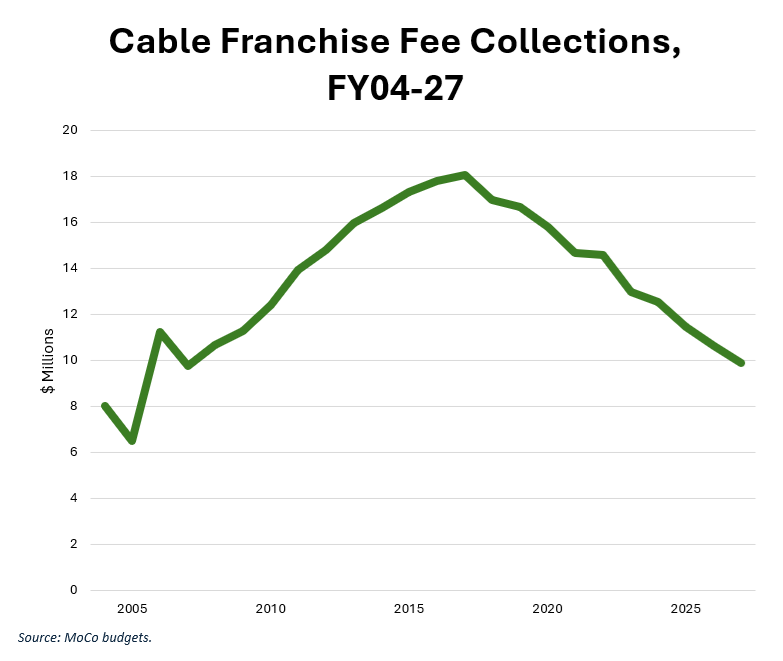
After many years of growth, cable fee collections peaked at $18.1 million in FY17. Then the cord cutting began. The county projects FY27 collections at $9.9 million.
But the picture is even worse when you dig into the numbers. First, in seven of the last eight fiscal years, the county overestimated fee collections. In FY19, fee collections came in $1.2 million below projections. In FY23, the shortfall was $1.35 million. This means cord cutting has been more aggressive than county budget estimators have anticipated. Second, the latest version of the county’s Cable Plan projects that franchise fees will fall to $5.5 million by FY31. This is a budget apocalypse in the making for every recipient of county cable money – including MCM.
So what has MCM done to adapt to these problems? MCM is a 501(c)(3) nonprofit whose finances are summarized in publicly available Form 990s. Let’s start by showing its total revenues in both nominal dollars and real (inflation-adjusted) 2025 dollars in the chart below.
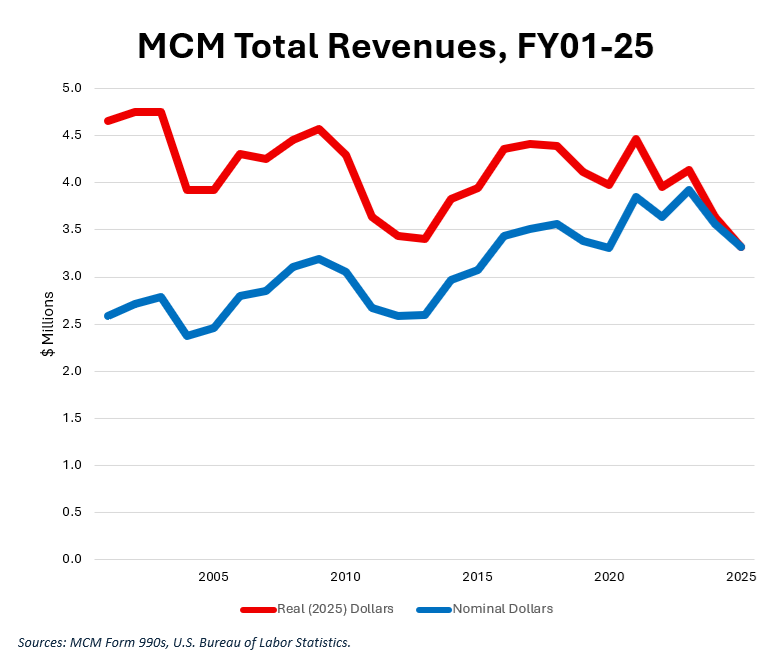
In nominal terms, MCM’s revenues have had dips during recessions, but mostly grew until peaking at $3.9 million in FY23. Two years later, revenues fell to $3.3 million, a decline of 15%.
However, when adjusted for inflation, MCM’s revenues are now at their lowest point since at least FY01. In real (2025) dollars, the organization’s revenues have fallen by 26% since FY21.
Additionally, MCM has trimmed its employee count from 75 in calendar year 2018 to 51 in calendar year 2024, the most recent year available.
Why is this happening? MCM has three main revenue sources: government grants/contributions (such as proceeds from the county cable fee), program service revenues (mostly contracts for specific services with the county) and other contributions/gifts/grants, such as funding from the general public. The percentages of total revenue represented by those three sources since FY12, when the IRS forms began their current methodology, are shown below.
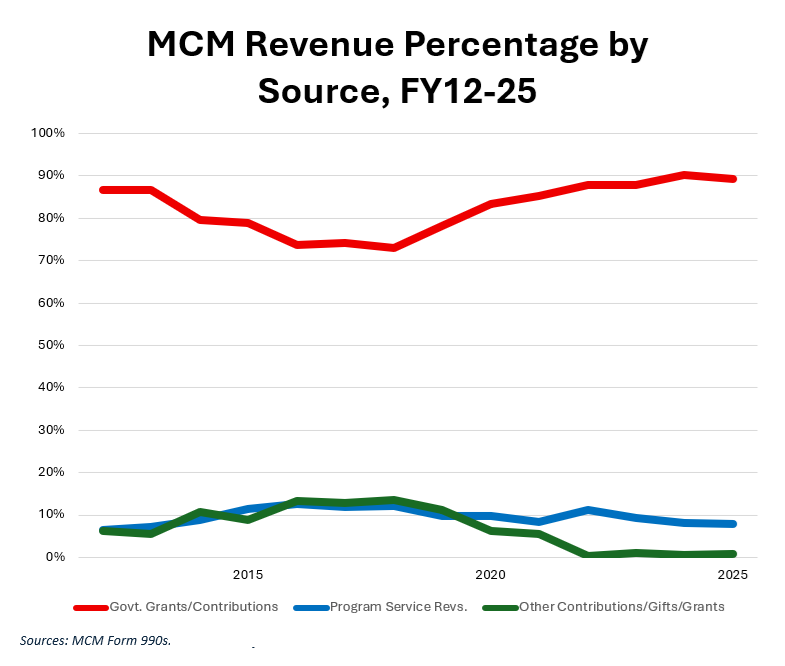
In the aftermath of the Great Recession, MCM’s leadership of that era tried to diversify the organization’s revenues away from county grants. They had some success, with both program service revenues and other contributions/gifts/grants exceeding $400,000 a year in FY16-18. That pushed down the percentage of MCM’s revenues coming from county grants from 87% in FY12 to 73% in FY18.
However, both of those alternative revenue sources have declined in recent years, with other contributions/gifts/grants coming in at less than $50,000 in each of the four years of FY22 through FY25. That has coincided with recent cuts in MCM’s share of county grants since FY24. According to county budgets, MCM’s appropriations from the county fell by 25% from FY24 through FY27.
Cable customers’ cord cutting has damaged MCM’s funding cord from county government. That’s why the council’s Office of Legislative Oversight (OLO) made this declaration three years ago:
OLO has concluded that the current structure of funding County telecommunications and public information activities though cable franchise revenues is most definitely not sustainable and does not align with the current state of technology, information dissemination, and customer preferences. The Council should consider how to modify the County’s telecommunications budget to reflect current conditions more accurately.
Next: Now that we have established its context, we return to Council Member Kate Stewart’s bill on governance.