
By Adam Pagnucco.
Part One discussed issues with campaign finance data from the State Board of Elections (SBE). Part Two described differences between the traditional financing system used by Council Member Andrew Friedson and the public financing system used by Council Members Evan Glass and Will Jawando. Part Three reported receipts, expenditures and cash balance. Part Four looked at donor type. Part Five looked at contribution geography. Part Six examined expenditures and burn rates.
How is this likely to play out in the end?
Let’s start by comparing the performances of Glass and Jawando to the 2022 performances of County Executive Marc Elrich and Council Member Hans Riemer. All four of these candidates used public financing to run for executive. The table below compares their cycle performance at the same point in the cycle – the January finance report in the election year.

Glass and Jawando have surpassed Elrich and Riemer on both receipts and cash balance at this point in the cycle. One reason for that is that the maximum allowed individual contribution has risen from $250 in 2022 to $500 now. Another reason is that both Glass and Jawando have more unique in-county contributors than either Elrich or Riemer did in January 2022. This is evidence of the popularity of public campaign financing and should make its legendary creator, former Council Member Phil Andrews, quite happy.
Another plus for Glass and Jawando is that the cap on available public matching funds has increased from $750,000 in 2022 to $870,170 now. Elrich and Riemer both hit the cap. I expect Glass and Jawando to hit it too. Add it all up – the increase in maximum contribution, the increase in the cap and the greater number of contributors – and Glass and Jawando should exceed the financial performance of their predecessors. In the 2022 cycle through the primary, Elrich raised $1,010,864 and Riemer raised $1,072,134. Glass and Jawando will raise more but we don’t know by how much – yet.
Another factor to consider is the matching funds cap of $870,170. When adding together the matching funds requested and already received, both Glass and Jawando are already now due to receive more than $500,000 – meaning that they are most of the way to hitting the cap. I believe they will both hit the cap at some time in the spring. Once they do hit that cap, they may still collect contributions from individuals of up to $500 each, but their fundraising pace will slow down. That puts a premium on controlling early spending, which (as we saw in Part Six) Glass has done well and Jawando has done less well.
Then there is Friedson. He is one of the great MoCo fundraisers in recent memory. A year ago, I calculated county executive fundraising in 2024 inflation-adjusted dollars since 2004. (This data has been erased by the State Board of Elections so I’m lucky that I crunched it back then.) The chart below shows the result of that analysis. Candidates in red won those races.
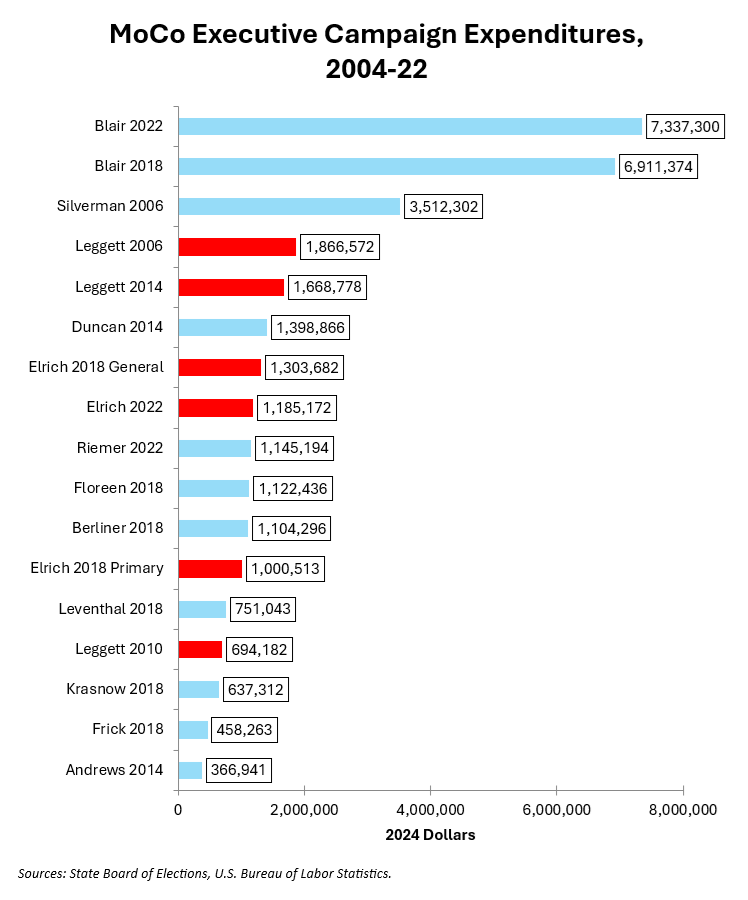
Friedson won’t reach David Blair’s numbers. The question is whether his inflation-adjusted take will match Council Member Steve Silverman, who raised twice what Ike Leggett did and still lost the 2006 primary. (Money isn’t everything, folks!) I’m not sure he will, but he may not need to.
I have run a few projections of where these candidates will ultimately land. The projections require assumptions about receipts and spending through June and vary a bit depending on those assumptions. This exercise involves not just math but a bit of judgment.
My gut tells me that Friedson will have at least $2.5 million to spend through the June primary while Glass and Jawando will have at least $1.1-1.2 million each. I’m being conservative so it could well be more. But in the end, I expect Friedson to have two and a half times the resources of each of his two opponents. That doesn’t make him the automatic winner since Silverman and Blair are examples of losing executive candidates with significant money advantages. Friedson also needs the extra money since he is running from a district and his opponents represent the entire county.
There are two other wildcards that deserve attention.
First, what will the outside groups do? Will the real estate community spend independent money to help Friedson? Will progressive groups spend independent money to help Jawando? And if the real estate folks attack Jawando while the progressives attack Friedson, will Glass be the ultimate beneficiary? Let’s keep an eye on all of that.
Second, Jawando has not relied exclusively on public financing so far. I have previously reported on his use of leftover funds from his U.S. Senate campaign and his federal PAC in ways that may benefit his county executive campaign. Will we see more of that? Will his opponents cry foul? Will it matter?
I can’t say, but here is the bottom line: we are witnessing a historic county executive race featuring three talented candidates. All three will have the resources they need to communicate with voters. And just as we are now comparing the 2006 and 2022 races to this one, we will someday measure future races by the standards being set today. It’s a hell of an election. Thank you for watching it with me.