
By Adam Pagnucco.
The county council’s pending tax credit bill for MCPS employees has a price tag currently projected at $25-30 million a year. That’s a fiscal challenge because the county faces a large structural deficit and might have to cut agency spending and/or raise taxes (again) next year. Now a county council office is criticizing the bill for possibly having “a negative impact on racial equity and social justice.” Are they right?
Among the documents considered by the council when deciding on legislation are racial equity and social justice impact statements prepared by the council’s Office of Legislative Oversight (OLO). In its statement on Bill 48-26, which establishes a $2,500 property tax credit for many MCPS employees, OLO writes:
The Office of Legislative Oversight (OLO) anticipates Bill 48-26 could have a negative impact on racial equity and social justice (RESJ) in the County. White community members may disproportionately benefit from creating a property tax credit for public school employees. Further, decreased property tax revenue from the Bill could undermine the County’s ability to provide public goods and services, which could particularly harm BIPOC community members.
OLO uses three data points to back up its conclusion.
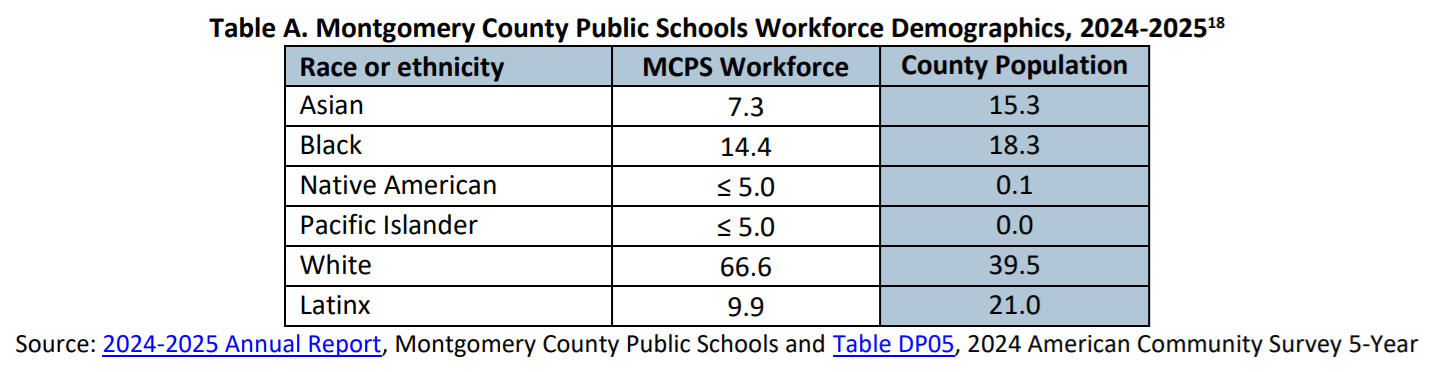
First, OLO cites MCPS’s 2024-25 Annual Report along with Census data to show that MCPS’s workforce is disproportionately White with underrepresentation by Latinos. This contrast is shown in the table below.
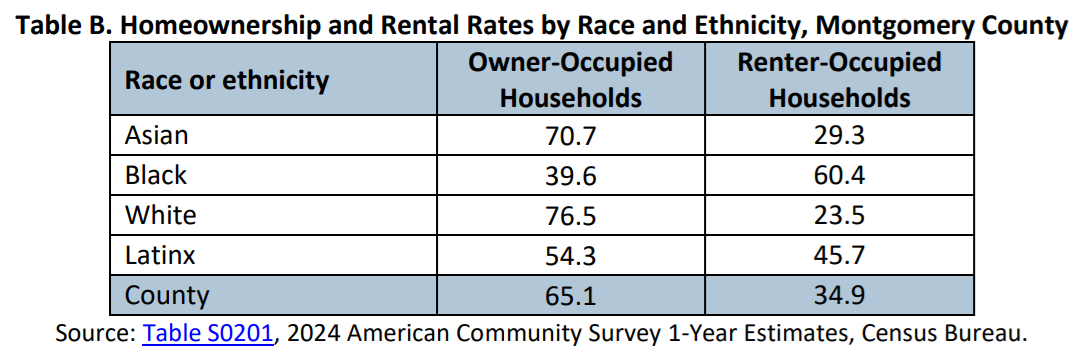
Second, OLO cites Census data shown in the table below illustrating that White and Asian residents are more likely to be homeowners than Black and Latino residents. Only homeowners in the county would get the tax credit in the bill.
Third, OLO crunches data from Census’s Microdata Access tool to make this finding:
OLO used the Microdata Access Tool (MDAT) from the U.S. Census Bureau to obtain estimates of community members in the County who live in owner-occupied homes and work in elementary and secondary schools by race and ethnicity. This data suggests White people are overrepresented among these community members, while Native American and Pacific Islander people are proportionately represented and Black, Latinx, and Asian people are underrepresented.
And so because the bill disproportionately benefits White residents, OLO believes it could harm racial equity. OLO also writes, “Further, decreased property tax revenue from the Bill could undermine the County’s ability to provide public goods and services, which could particularly harm BIPOC community members.”
Is OLO correct?
It’s impossible to deny that MCPS’s workforce is majority White and that Whites have higher home ownership rates than Black and Latino residents. If I were inclined to defend the bill, I would ask whether Blacks and Latinos disproportionately need property tax credits to afford to buy homes in MoCo, so granting them could benefit racial equity for the recipients. OLO also points out that Black and Brown teachers have higher turnover rates than White teachers, so if tax credits help with retention, Black and Brown teachers might benefit more than their White colleagues. Finally, there is also academic research linking long teacher commute times to higher turnover and negative educational outcomes. Could Black and Brown students, along with all other students, benefit from cutting teacher turnover? I don’t know if this outweighs OLO’s points but it belongs in the mix.
Another argument worth considering was made by Georgetown University professor and MCPS parent Nora Gordon in her critique of the tax credit. Gordon wrote, “No one would propose higher salaries for staff who own rather than rent, yet the Council appears willing to achieve the same ends with this policy.” Also of note is that the bill’s lead sponsor, Council Member Kate Stewart, may amend the bill to exclude part-time employees to reduce its cost. This suggests that the bill will exacerbate economic inequality among MCPS’s staff by disproportionately rewarding high earners who can afford to buy expensive MoCo homes while giving nothing to lower paid employees who either rent or live outside the county.
Finally, none of this speaks to the massive cost of the bill, currently estimated at $25-30 million a year. Even if Stewart cuts its cost, the price tag may be big enough to make it more difficult for the county to afford fully funding MCPS’s next operating budget request. What does that mean for racial equity and academic outcomes?
I wish the council would consider this bill within the context of next spring’s budget process so they could evaluate it against other priorities and figure out how to pay for it. With so many questions raised by OLO and others and a nine-digit structural deficit looming over the county, prudence and balance should take precedence over speed and politics.