By Adam Pagnucco.
Last week, a Super PAC opposing State Question 3 sent out a mailer implying that Governor Wes Moore and several other prominent elected Democrats opposed the ballot question. In fact, all of these Democrats support the ballot question. Another Super PAC supporting the question quickly sent out a blast email blaring “MAGA is lying to you about Question 3” and quoting my post.
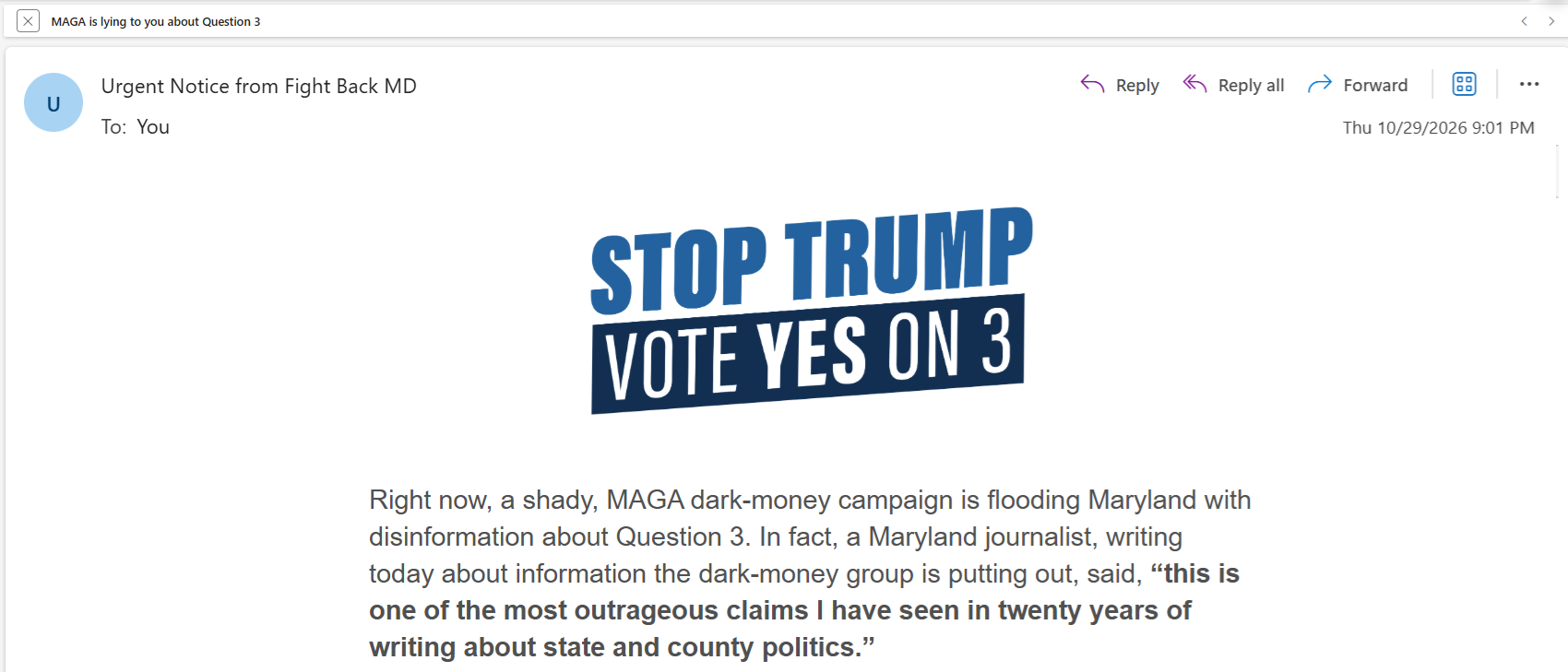
The email from Fight Back MD.
Lie or not, the exchange prompts this question: is it legal to lie during elections?
The short answer: it’s complicated.
Let’s start with a 2022 briefer on Congress’s website titled False Speech and the First Amendment: Constitutional Limits on Regulating Misinformation. The briefer starts with this statement:
Federal and state legislators have expressed interest in regulating online misinformation and disinformation. Such regulatory efforts may implicate the U.S. Constitution’s First Amendment. The Supreme Court has said the Free Speech Clause protects false speech when viewed as a broad category, but the government may restrict limited subcategories of false speech without violating the First Amendment. For example, defamation, fraud, political advertisements, and broadcast speech are subject to special considerations.
Defamation, which is the use of false statements to harm a person’s reputation, is addressed by the Supreme Court’s landmark decision of New York Times Co. v. Sullivan, 376 U.S. 254 (1964) in the case of public figures. The court decided that public figures may successfully bring defamation actions against defendants who either deliberately lie about them or publish statements “in reckless disregard of the truth,” in other words, without conducting due diligence on them. The court elaborated, “Factual error, content defamatory of official reputation, or both, are insufficient to warrant an award of damages for false statements unless ‘actual malice’ — knowledge that statements are false or in reckless disregard of the truth — is alleged and proved.”
Fraud, false commercial speech, perjury, lying to law enforcement, statements designed to incite imminent lawless action, impersonation of government officials, interfering with voting and child pornography are generally not protected by the First Amendment.
Laws mandating disclosures about sources of campaign speech are not prohibited by the First Amendment. Accordingly, political advertisement disclaimers and disclosures of contributions to campaign committees are commonly required by election bodies across the United States. Some states also prohibit lying for the purpose of interfering with election administration. (More on that below.)
But what about the speech itself? Defamation laws and election administration aside, is lying during elections legal?
In United States v. Alvarez, 567 U.S. 709 (2012), the Supreme Court wrote this:
*****
The remedy for speech that is false is speech that is true. This is the ordinary course in a free society. The response to the unreasoned is the rational; to the uninformed, the enlightened; to the straight-out lie, the simple truth… The First Amendment itself ensures the right to respond to speech we do not like, and for good reason. Freedom of speech and thought flows not from the beneficence of the state but from the inalienable rights of the person. And suppression of speech by the government can make exposure of falsity more difficult, not less so. Society has the right and civic duty to engage in open, dynamic, rational discourse. These ends are not well served when the government seeks to orchestrate public discussion through content-based mandates.
*****
Accordingly, it’s very difficult to regulate the content of political speech in the United States, whether it contains truth, half-truths or outright lies. The Supreme Court’s guidance to us is that if we dislike a lie, we should counter it with the truth. The National Conference of State Legislatures, the Knight First Amendment Institute and University of Texas law professor Joshua S. Sellers elaborate with further case law.
I know of two state laws in Maryland that address political speech.
MD Code, Election Law, § 2-110 allows the State Board of Elections to seek civil damages against defendants spreading election misinformation (defined as “incorrect or misleading information regarding the time, place, or manner of an election, election results, or voting rights in the State”) or election disinformation (defined as “incorrect or misleading information regarding the time, place, or manner of an election, election results, or voting rights in the State that is knowingly and deliberately disseminated”). Maryland is one of twelve states to have such a law.
MD Code, Election Law, § 16-905 creates a misdemeanor criminal offense for the use of a “deepfake” in an election. Deepfake is defined as “an image, an audio recording, or a video recording that has been intentionally created or manipulated with the use of generative artificial intelligence or other digital technology to create a realistic but false depiction of a person that an ordinary person would conclude is an actual visual or audio representation of the person depicted.” Exemptions are made for satire and parody and media outlets that republish deepfakes – in other words, the original authors of the deepfakes are targeted. This law was passed earlier this year and I am unaware of whether it has been tested in court. But it definitely could be in the future.
And so given the state of American case law, the most effective sanction against political lying will probably not come from the courts. It will come from you, the voter. If a candidate or interest group lies to you, vote against them. Doing so is in your own self-interest as a lying candidate will lie some more, and possibly cheat too, if elected to office.
Always remember: honest government is never produced by dishonest politicians.