
By Adam Pagnucco.
Part One described the nature of independent expenditure (IE) entities and Super PACs, which may raise and spend unlimited sums on supporting and opposing candidates but are prohibited from coordinating with them. Part Two identified eight of these entities who played in our elections for county executive, county council, sheriff and school board. Now let’s look at their spending.
The eight IEs and Super PACs who participated in our county primary spent a collective $3,374,424 on supporting or opposing candidates. That’s almost equal to the $3,750,621 that taxpayers spent on public campaign financing through May. The pie chart below shows the percentage distribution by group.
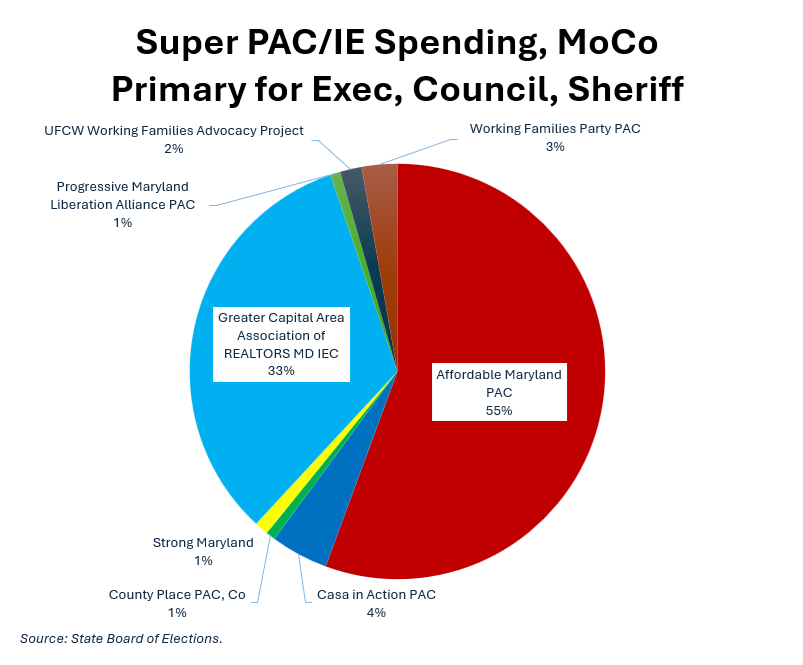
The real estate-financed Affordable Maryland PAC led the way with $1,876,683 in independent expenditures, or 55% of all spending. The realtors’ Super PAC was next with $1,108,969, an additional 33% of all spending. The Casa in Action PAC spent $151,065 (4%). No other entity spent more than $100,000.
The real estate entities outspent everyone else by nearly eight to one.
The table below shows tallies of supporting and opposing spending by candidate.
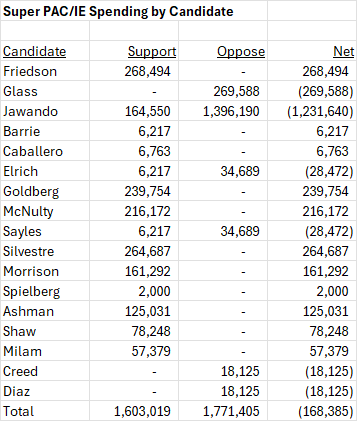
County executive candidate Will Jawando will go on to win the primary despite having more money spent against him on net than any other county candidate in MoCo history. That’s because of the Affordable Maryland PAC’s negative TV ads. However, the real estate entities did better on the council races, and if Karla Silvestre and Jud Ashman go on to win, their support will have made a difference.
Now let’s look at two types of spending specifically designed to reach voters. This contrasts the two real estate entities with the progressive entities (all other groups except for County Place PAC, Co).
TV: The Affordable Maryland PAC spent $1,655,704 on negative TV ads against Jawando and Evan Glass. Casa in Action PAC spent $5,000 on TV promoting their endorsed candidates.
Direct Mail: The real estate entities spent $212,218 on mail. The progressive groups spent $85,358 on mail. That latter amount is barely capable of paying for one countywide mailer, suggesting that the progressives ran targeted mail.
An additional factor in the spending was that the progressive groups spent 35% of their sum on salaries whereas the real estate groups spent 25% (and Affordable Maryland PAC spent zero). If the progressives had spent larger percentages of their expenditures on TV, mail and digital, they would have been more effective. That said, since they were outspent by 8 to 1 and still helped elect Jawando, they were effective enough.
One note: there is no financial data that can adequately quantify the impact of the Apple Ballot. A volunteer teacher beats a paid canvasser any day of the week, and thousands of Apples can largely offset thousands of mailers. The Montgomery County Education Association (MCEA) does not show up in the above data, but I bet its aid was the biggest single help in getting Jawando elected.
Finally, the fact that Super PACs, some of which relied on outside and even “dark” money, spent millions of dollars on our election warrants discussion. Most MoCo candidates rely on public financing, which sets limits on the size of individual contributions and the disbursement of matching funds. These candidates are sitting ducks for Super PACs who can enter their races at any moment and outspend them in a matter of days. After the dust from this election settles down, county leaders should discuss what can be done to help publicly financed candidates confront sudden and massive Super PAC expenditures. It happened this year. There is no reason to believe that it won’t happen again.