
By Adam Pagnucco.
In a recent column, I revealed that the county’s latest six-year fiscal plan projected that county agencies – the largest of which are county government, MCPS, Montgomery College and Park and Planning – will have to take a $134 million cut next year. But there is an asterisk: some of these agencies are largely protected from cuts while others are not. That means those who are unprotected must bare their necks to the guillotine while their colleagues mostly escape the blade.
First, for reasons I laid out in my earlier column, I am skeptical that there will be any cuts at all. Ever since the Great Recession forced draconian choices, county leaders have long preferred tax and fee increases to controlling spending. But suppose there were actual cuts. Who is vulnerable and who is not?
The key to understanding this is realizing that MCPS and Montgomery College are covered by state maintenance of effort (MOE) laws that impose spending mandates on local governments. One reason why these laws exist is that the state sends more than $9 billion a year to local governments for the purpose of funding school districts and community colleges. Without MOE, local governments could easily shift local appropriations away from schools and colleges towards other purposes, thereby supplanting state money and defeating the purpose of state aid. Accordingly, local spending mandates for schools and colleges exist to ensure that state aid is actually used to support spending for those purposes and not diverted to other things.
The mechanics of MOE laws differ by recipient. For Montgomery College, the county’s contribution in one year must at least match its contribution in the prior year. For example, in FY24, the county appropriated $148 million in local money to the college, so its required MOE contribution in FY25 was also $148 million. For MCPS, the required local contribution is expressed as local money per student. In each case, the county may go above its required contribution, but if it does, the new higher amount becomes the floor for next year.
Three years ago, I wrote a history of recent changes to the MOE law for public schools. The bottom line is that MOE requirements are not strictly absolute – the state may grant waivers from them in extreme cases – but they are very difficult to get out of. And if state agencies choose not to grant relief, counties are stuck. In the case of schools, counties that run afoul of MOE mandates run the risk that the state will redirect their income tax receipts directly to school budgets.
In the meantime, Montgomery County Government (MCG) and Park and Planning have no such protections. The county council may cut them at will. And they know it.
The result of partial protection by MOE laws is disparate budget vulnerabilities between agencies. In the FY26 approved operating budget, MCPS and the college together accounted for 52% of spending while MCG and Park and Planning accounted for 42%. (The rest went to debt service.) While MCPS might have to take a tiny cut if its enrollment drops and it is held to the same per-pupil local contribution, the overwhelming burden of any spending cut will fall on MCG and Park and Planning.
This is not a hypothetical scenario. During the Great Recession, the county almost ran out of money and could not sustain its required MOE contribution to MCPS. It cut its per-pupil contribution three years in a row, causing the state to tighten up its law. Meanwhile, fearing that they would take bigger cuts than MCPS, the police and fire fighter unions launched pickets of county council fundraisers. Check out the pictures from 2010 below in which public safety picketers carried signs comparing MCPS to a pig and asking, “When has someone died from a teacher not showing up to work?”
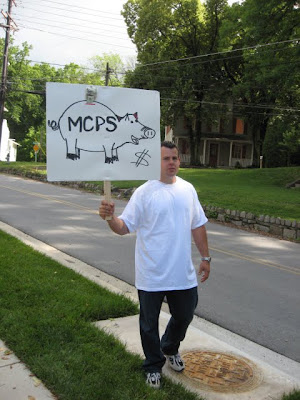
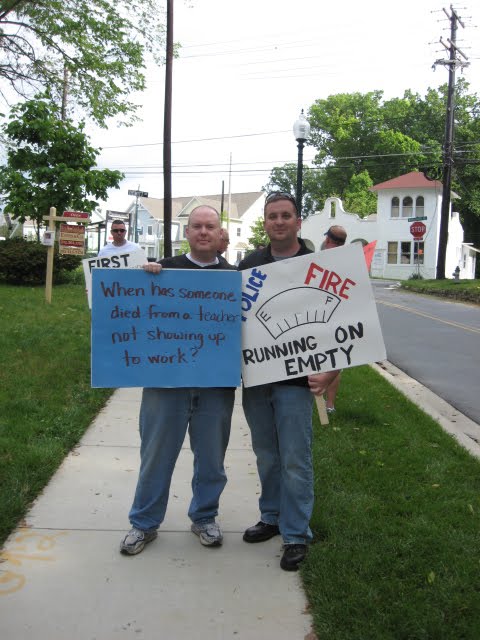
Back in the day, the police and fire fighter unions were not big fans of MCPS.
Today’s county government union leaders are well aware of MOE laws and their lack of protection from them. This is particularly true of MCGEO President Gino Renne, who was in office during the Great Recession. This awareness was a big factor in why the police and fire fighters often diverged from the MCPS unions in their endorsements this year. They wanted to have receptive ears in case the budget got tough. Well, folks, the budget is getting really tough right about now.
The state has a legitimate interest in protecting state aid from being supplanted and diverted. That said, any cuts are more easily borne across the entire government than just 42% of it. That’s what MCGEO, the police and the fire fighters will point out if any cuts actually get placed on the table.
And that’s one of the biggest reasons why there may not be any cuts at all. In that case, the easiest way out for county leaders will be another large tax increase.