
By Adam Pagnucco.
On Monday, I wrote a post titled A Path to Ruin? Or a Path to Balance? The post contrasts the county’s massive structural deficit with a huge pending tax credit bill that would have created a new annual entitlement exceeding $20 million a year. The bill, which would establish a new $2,500 tax credit for many homeowners employed by MCPS, comes after the loss of $692 tax credits previously possessed by most county homeowners. While it offers a significant benefit to its recipients, it needs to be considered in the context of a complete operating budget with other priorities, notably MCPS’s budget, which is always large and important.
On Tuesday, one county council member made the same argument as this tax credit and two others came to a vote. He argued for fiscal responsibility and balance in the face of a growing deficit. And he carried the day.
This council member was the incoming county executive, Will Jawando.
Let’s review the three tax credit bills. Bill 46-26 would establish a $500 per child tax credit for low income homeowners. Its cost is projected at more than $6 million per year. Bill 47-26 would expand eligibility for an existing tax credit for low income homeowners. Its cost is projected at $5-8 million per year. Bill 48-26 would provide $2,500 tax credits for most homeowners who are MCPS employees. As amended in committee, its cost is projected at $20-23 million per year. If passed together, the three bills would add $31-37 million per year to the county’s FY28 structural deficit, which was estimated at $293 million in May. Since each penny of the property tax rate generates $26 million for the county, the combined cost of the tax bills is equivalent to a more than one percent increase in residents’ property tax bills.
Now we come to Jawando, who is still on the council but will be inaugurated as county executive next month. The executive and the council have different roles on the county’s budget, summarized this way: the executive proposes and the council disposes. Of the two jobs, the executive’s is harder (and I write this as someone who used to work at the council.)
The executive’s recommended operating budget is non-binding and is subject to final approval by the council, but it is an extraordinarily difficult document to produce. The executive and his staff must weigh budget requests by the departments and agencies (the latter including MCPS, Montgomery College and Park and Planning) against available revenues, state mandates, cash requirements of the capital budget and mandatory expenses (like debt service).
Under the charter, the annual operating budget must be balanced. Structural deficits refer to projected gaps between ongoing revenues and ongoing spending in future years. Small ones can be resolved without too much fuss, but big ones (like the one we have now) can be serious threats.
The council may rewrite the executive’s budget, but they usually only tweak it. For example, the council trimmed County Executive Marc Elrich’s recommended FY27 operating budget by just one percent last spring.
Accordingly, Jawando is starting to think and act like an executive, and well he should. As the council began discussion on the three tax credit bills on Tuesday, he made motions to table all three of them. While praising their intent, he said this as consideration of the child tax credit commenced.
*****
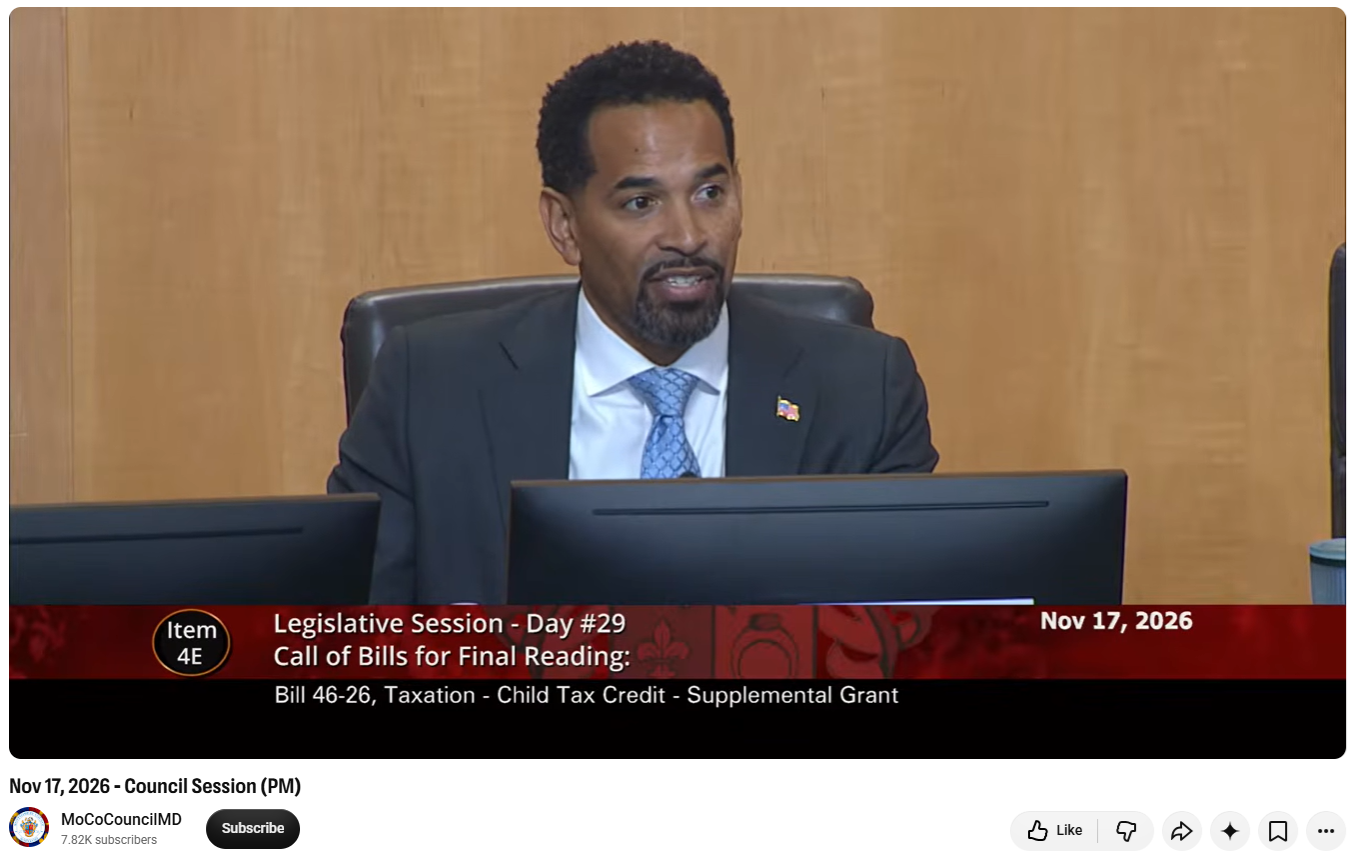
Council Member and County Executive-Elect Will Jawando.
The reason I’m asking colleagues to postpone this bill today is for three reasons.
The first is our budget. This morning, we had a sobering briefing on the fiscal pressures in front of us and we have a large projected deficit for the next year. I’ve been in transition meetings and it’s actually higher than has been reported in the press of $300 million, it’s more than that. This bill would cost $6 million a year starting in FY28, more than $31 million over the next six years. And it does not say where the money comes from.
The second is how the bill is written. It requires the director of finance to make this payment every year, which takes it out of the annual budget where the executive and council weigh every need side by side.
The third is timing. We are twenty days, twenty days from a new executive and council. I was invoked nineteen times today – I’ve been keeping track here – about things that I need to do as county executive and the new council would need to do. In Fiscal Year 2028, it’s the first budget that I will send to the council a mere three months and 26 days from now. I commit to looking at this proposal as we work to build the budget, as I build the budget that I’ll send over and we work with council to get a budget passed. And with Council Member Stewart and the next council on the best way to help these families.
I’m asking my colleagues, including those who signed onto the bill as it’s meritorious to support the motion to postpone at this time.
*****
Council Member Evan Glass, who ran against Jawando in the county executive primary, seconded the motion. The motion passed, with Jawando, Glass, Marilyn Balcombe, Natali Fani-Gonzalez, Dawn Luedtke, Kristin Mink and Laurie-Anne Sayles voting in favor and Shebra Evans, Andrew Friedson, Sidney Katz and Kate Stewart voting against. Jawando’s motion to postpone the MCPS tax credit bill passed on an identical tally. Jawando’s motion to postpone the homeowner tax credit bill failed and the council passed it on a 6-5 vote, but they need seven votes to override a potential veto by County Executive Marc Elrich.
Let’s take stock of what happened here. No one spoke against the purpose of any of the tax credit bills. If the county had the money to afford them, all three would have passed unanimously. But the county doesn’t have the money because the structural deficit could now be big enough to rival the calamitous ones the county faced during the Great Recession.
Jawando showed that he recognized that. He exhibited political courage, fiscal discipline and leadership, and he was able to rally a majority of the council to his side on two of the three bills.
We shall see what the future holds, but this was a good day for the incoming county executive.