
By Adam Pagnucco.
Last year, I published a startling fact: MCPS was running a $58 million deficit in its fund that pays for employee and retiree health care, an amount comparable to the county’s annual budgets for recreation, libraries and environmental protection. One year later, the news is even worse:
MCPS’s health care hole is now $97 million.
Why is this happening and what can we do about it? First, let’s understand MCPS’s health care funding structure. MCPS pays for employee and retiree health care claims through its Employee Benefits Plan (EBF), a segregated fund supported by money from the school district, employees and retirees.
As recently as FY22, the EBF had a positive fund balance. But health care costs have gone through the roof since then. Insurance companies in both Maryland and D.C. have recently sought huge increases greatly exceeding inflation while the State of Maryland just approved a 14.6% average premium increase for individuals in the state’s Affordable Care Act marketplace. Additionally, usage of expensive weight loss drugs like GLP-1s is spiking. MCPS is not immune to these factors. Neither are private employers, employees or individuals.
Check out the table summarizing EBF finances below, which was presented to the school board’s Fiscal Management Committee on September 15. It’s a pithy summary of a brutal reality.
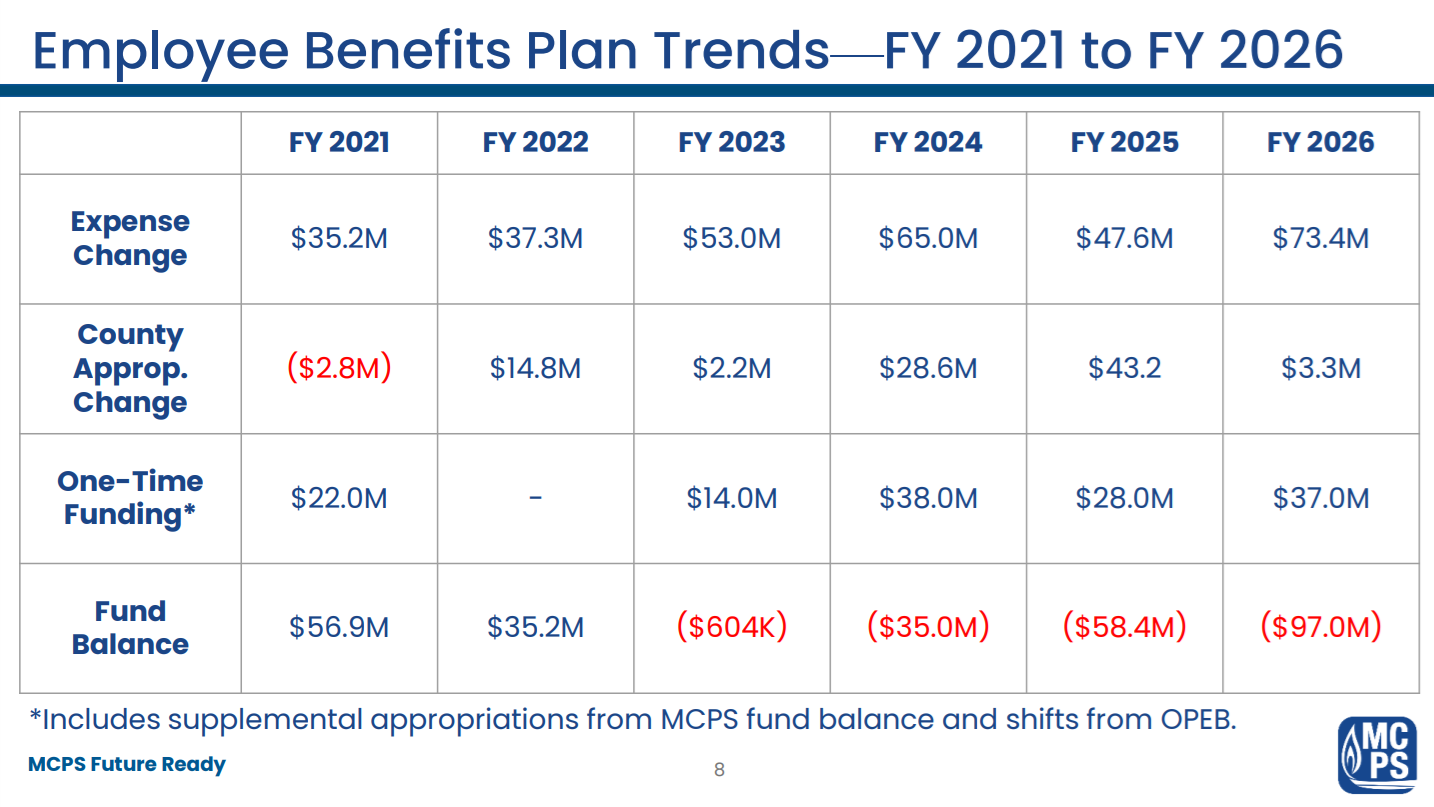
The top line is the change in EBF expenses each year from FY21 through FY26. Not only are those expenses increasing, but with the exception of FY25, they are accelerating. (Part of the variation lies with the number of high claims individuals, who are folks with more than $100,000 in claims each year.)
Now let’s look at the next two lines, each of which show revenue increases for the fund. The second line shows change in appropriations, which are long-term budget increases allocated to the EBF. In four of the table’s six years, these changes have been low or flat. The third line shows one-time revenues, such as draws from fund balance or other post-employment benefits (OPEB) money. In four of the six years, these revenues exceeded $20 million. They are essentially band-aids because they apply to one year only and don’t go into MCPS’s base budget. The county council approved these band-aids as an alternative to permanent budget increases under the state’s maintenance of effort law.
The final line is the EBF’s fund balance. In FY21, the fund balance was $57 million, meaning that MCPS could pay for its health care claims and still have tens of millions of dollars left over. By FY26, the fiscal year that just ended, MCPS had a fund balance of negative $97 million. Health care is now turning into a destabilizing threat to the district’s cash management.
MCPS has tried to manage these cost increases through contract changes with providers (Prudent Rx, Cigna and Caremark) as well as shifting costs to employees. However, the changes produced minor savings, often in the single digit millions. And once the two percent cost shift to employees is fully phased in, the extra revenues will only amount to $10 million a year. It’s not enough compared to the $97 million – and growing! – deficit.
One factor that’s driving some of these costs is usage of GLP-1 drugs, which MCPS covers for both diabetes and weight loss. MCPS told the school board’s Fiscal Management Committee (comprised of Karla Silvestre, Julie Yang and Natalie Zimmerman) that GLP-1 costs were $34 million in FY24, $64 million in FY25, $80 million in FY26 and more than $100 million projected this year. When Silvestre asked the staff how much money could be saved by not covering GLP-1s for obesity, the staff replied that it would be $40 million.
The press has reported that MCPS is having rocky negotiations with the teachers union right now. I wonder if this health care hole is one reason why. Another item of note: MCPS staff told the school board committee that they believe the county government is having similar problems paying for GLP-1 use.
In the short term, it seems like MCPS has three ways to pay for these cost increases since their existing contract and cost shifting tactics have not generated sufficient savings.
First, the district could try moving money from other places in its budget towards paying health care expenses. But that could affect position counts in the immediate aftermath of hundreds of position eliminations.
Second, the district could shift more costs to employees and/or trim benefit coverage. But those changes would have to be negotiated – hence the above-cited tough bargaining – and a two-point cost shift brought in just $10 million.
Third, the district could ask for more from taxpayers. But taxpayers are already angry over a huge property tax bill increase and will likely owe more money to avoid county agency cuts. And taxpayers have their own health care cost increases to pay for as well.
No one wants to pay for MCPS’s huge health care hole, but someone will have to. We will find out the identities of the afflicted as the FY28 Doomsday Budget season approaches.