
By Adam Pagnucco.
Defying a cascade of warnings from the real estate industry and decades of evidence on its failures, the county council passed a permanent rent control law in 2023. Since then, a deluge of data points has confirmed the damage this law has wreaked on the local economy, including collapsing apartment sale transactions, redlining by the national real estate industry, complaints from local developers that they can’t get financing for their projects, a near evaporation of non-government-subsidized multifamily projects and disappearing revenues for the county’s capital budget. The debacle has caused incalculable damage to the county’s reputation. And now new evidence shows the toll of lost real estate development, this time coming from the county agency that regulates it.
The Department of Permitting Services (DPS), which issues permits for business and real estate activities, operates as an enterprise fund with permitting fees covering its costs. DPS issues many kinds of permits, including for electrical work, mechanical work, sediment control, fire code enforcement and many more, but its single largest revenue source is building permits. As with other departments, DPS’s annual budget contains approved amounts for the current and immediate prior fiscal year as well as actual amounts for two years prior. This enables comparisons of projected revenues with actual revenues, although with a time lag.
Unlike many other departments, DPS must project its fee revenues when establishing its budget. That is HARD. First, economic forecasting of any kind is difficult, and estimating permit fee collections depends on that. Second, DPS must not merely forecast activity, but it must estimate the kinds of projects for which applications are filed because the permit fees vary widely. I don’t envy the folks who have to make these estimates.
Given that variability, one would expect that DPS would sometimes overestimate its future building permit revenues and sometimes underestimate them. Looking at its past budgets from FY05 through FY24 (the fiscal year before rent control took effect), DPS underestimated its building permit revenues 14 times and overestimated them 6 times. On 13 of those occasions, DPS’s projection came within 20% of the actual. That doesn’t sound like a great forecasting record, but at least the department is usually conservative.
That has changed since rent control took effect in FY25. For that year, DPS projected building permit fee collections at $26.8 million. They actually came in at $22.2 million, 17% below forecast.
In FY26, DPS projected building permit fee collections at $24.6 million. They are now estimated to be $19.9 million, a shortfall of 19%. And it’s not just building permits. Nearly every major DPS permit fee – electrical, fire code, grading, sediment – is also off.
Here’s another data point. In twenty years of its budgets, DPS has never come in below a building permit revenue estimate by double digits in consecutive years. What’s happening now may be unprecedented.
The county council was warned about DPS’s financial problems in an April 30, 2026 council staff memo. DPS is an enterprise fund, so it has a fund balance to cushion it from variations in revenues and costs. In the past, that fund balance has been significant, but it is now falling. Council staff wrote that “the decline is projected to accelerate in FY27.”
Council staff identified two reasons for DPS’s shrinking fund balance. Following is an excerpt from their memo to the council along with a chart.
*****
The cause of the growing discrepancy between revenues and operating expenses is two-fold. First, operating expenses grow year-over-year, and it is not easy to manage or reduce them annually. This is because DPS staff receive wage adjustments that are not determined by DPS, and therefore do not account for the fluctuations in DPS revenue.
In addition, when revenues decline, meaning there is less permit activity, DPS does not reduce its staffing level commensurately. It is difficult to adjust staffing on a yearly basis from a management perspective. Overall, personnel costs are not as flexible as fee revenue for addressing budget gaps. Therefore, when revenue is projected to decline, it is more likely the department would pursue a fee increase than adjust staffing.
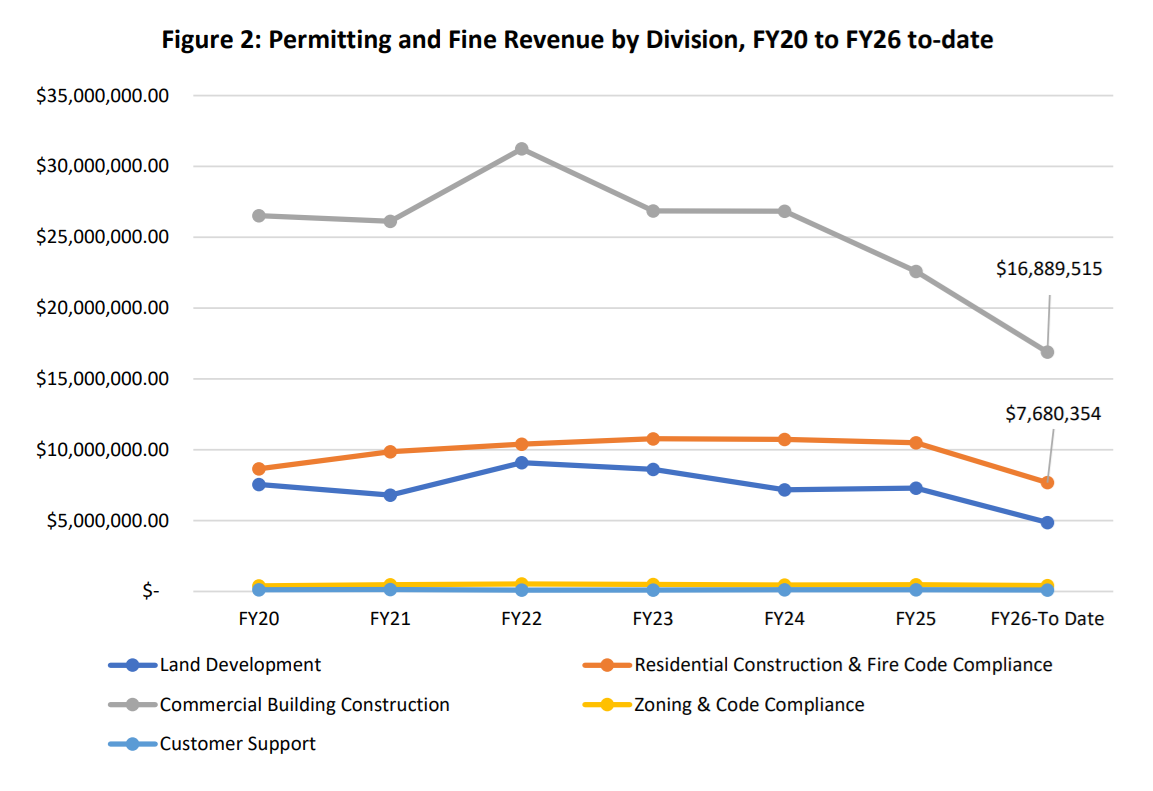
The second cause of the rapidly declining fund balance is the sharp decline in activity from the department’s largest source of permitting revenue, Commercial Building Construction. According to DPS staff, this dip is due largely to a “sharp and sustained slowdown in large mixed use and multifamily high rise new construction, multifamily low rise new construction, and business building alterations projects, that started in the 2nd quarter of FY25 and continued into FY26.” DPS Staff suggest this may be explained “by construction costs, financing costs, and the broader economic conditions that have shifted dramatically over the past 12-18 months.” Figure 2 show the change in revenue by division, include fines, since FY20.
*****
Are construction costs, financing costs and broader economic conditions causing this? If they are solely responsible, than why are most of our large neighbors building hundreds or (in some cases) more than a thousand multifamily units each year while we have stalled in most quarters since passing rent control? Few if any county officials want to admit that rent control is a factor in this because it would be impolite to the many elected officials (and taxpayer-funded groups) who support it regardless of its damage to the county’s economy.
So what did the council do about this revenue collapse? Did they amend the rent control law to make it less discouraging to development as county planners have asked them to do?
Come on now, folks, this is MoCo! The county executive reacted to the shortfall by recommending fee increases of 25% for commercial permits and 10% for residential permits. The council instead approved a flat fee increase of 15% for both permit types. So the folks who are still choosing to do business here will pay more to make up for those who have chosen to walk away.
Can anyone make this make sense?