
By Adam Pagnucco.
Every one of you who pays for gas knows this: the price of gasoline has shot up since President Donald Trump launched his war on Iran in February. But the pain of this price increase won’t just show up at the pump. It could be showing up in your state and local tax bills too.
First, the U.S. Bureau of Labor Statistics released its latest consumer price index (CPI) estimates yesterday. Trump’s war is dramatically affecting both gasoline and diesel prices as crude oil flows slow and energy infrastructure is destroyed. The chart below shows annual increases in motor vehicle prices measured by the Washington-Arlington-Alexandria CPI-U since 1999, the first year of the data series. The final year in the chart reflects the 12-month change through September 2026.
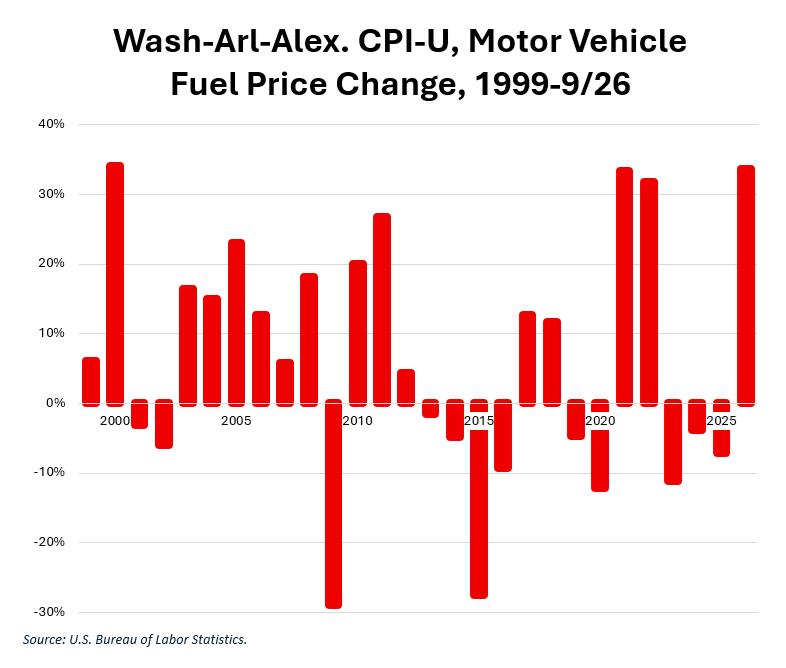
Motor vehicle fuel prices are erratic, often varying by double digits in a year. At this writing, the 12-month increase through September 2026 (+33.6%) is slightly higher than the two pandemic years of 2021 (+33.3%) and 2022 (+31.8%) and is the highest since 2000 (+34.1%). Most variations in prices are due to market-based mismatches between supply and demand, but Trump’s war has directly caused a supply disruption due to Iranian retaliation against oil shipping, pipelines and refinery assets as well as Trump’s blockade on Iran’s exports.
Fuel price inflation is just starting to affect other prices. In terms of total price inflation, the Washington-Arlington-Alexandria CPI-U rose by 4.125% over the twelve months ending in September 2026. When compared to annual local inflation rates, that’s below the 6.6% increase in 2022 (the height of the pandemic) but is otherwise higher than any other annual local inflation rate since 1991. And Trump’s war shows no sign of ending soon.
As this site is concerned with the activities of state and local governments, consider the vehicles that these governments and their contractors operate.
School buses
Metro and Ride On buses
Police cars
Fire trucks
Ambulances
Road maintenance vehicles
Snow plows
And more!
The Montgomery County Government has roughly 3,600 vehicles and MCPS operates more than 1,300 school buses. Both agencies consume millions of gallons of fuel – fuel that costs a LOT more due to Trumpflation.
Consumers can modify their travel behaviors to an extent to offset higher gas prices, but governments can’t. School buses must still meet their routes. Police cars and fire trucks must still respond to service calls. Plows must still clear snow. The only difference is that those activities will now require more tax dollars. And since both the state and county already have financial challenges, Trumpflation will exacerbate them.
During past experiences with inflation in the 1970s and the pandemic, we learned two things. First, when inflation gets going, it’s hard to stop quickly. It can continue for years after original causes (like oil shocks) abate. Second, when prices increase, they often fail to fully return to lower levels as inflation recedes. Economists refer to this phenomenon as prices being “sticky downwards.”
And so it appears that Trumpflation could outlast the Trump administration itself.