
By Adam Pagnucco.
Part One covered the methodology of this series. Part Two looked at total employment. Part Three examined federal government employment. Part Four reviewed private sector employment. Now let’s look at construction employment.
The construction industry is a critical part of any locality’s economy. It is the beneficiary of economic growth, which often leads to the development of real estate. It contributes to economic growth through its resultant creation of profits and jobs. It is also an employer of skilled labor that does not always require four-year university degrees. A healthy construction industry is both a sign of and a necessary part of a strong economy.
That said, the industry’s structure makes it a strange beast, at least in terms of analyzing it using payroll data. That’s because many construction employers are not purely local in nature. Many of them have operations and employees spread across several jurisdictions. For example, it’s entirely possible for a MoCo-based contractor to employ workers living in Prince George’s and Frederick on projects in Arlington and Fairfax. So data series like those available from the U.S. Bureau of Labor Statistics are better used to examine general trends than specific micro-comparisons.
With that caveat in mind, let’s look at construction employment in the Washington-Arlington-Alexandria metro area since 2001. This series includes mining and logging, but how much of that is there in our region?
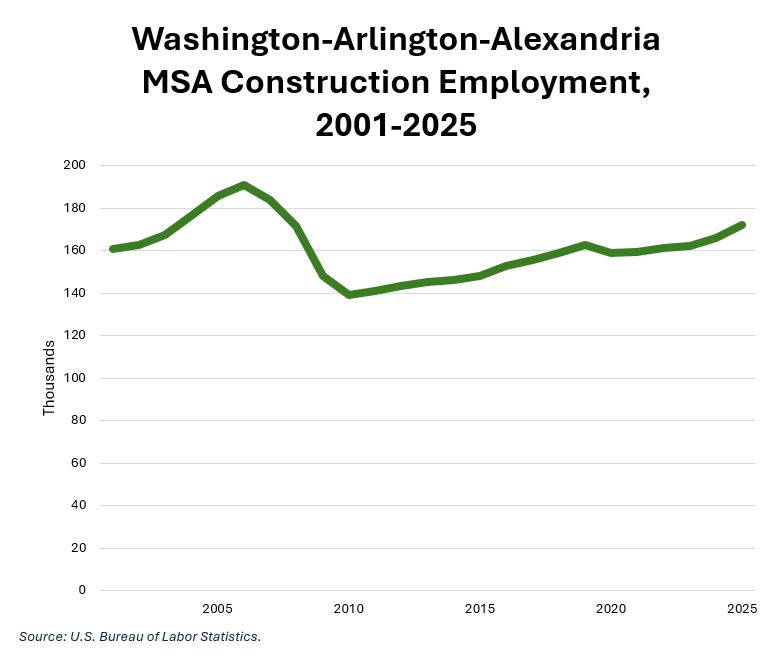
Remember the big boom prior to the Great Recession? This chart illustrates that boom, with regional construction employment peaking at 190,700 in 2006. The Great Recession then brought down the market, but a slow recovery brought the region to 171,900 jobs last year. This general pattern of boom, bust and recovery will affect the operations of construction contractors all over the region.
Now here is what construction employment has looked like for MoCo employers over the same time period.
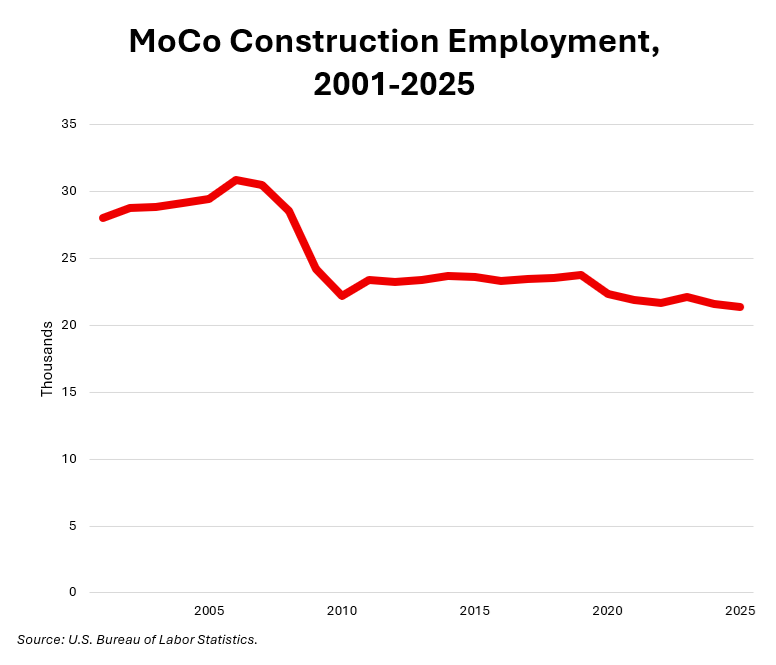
As with the region, MoCo construction employers peaked in 2006 (with 30,890 payroll jobs). But unlike the region, our employers never rebuilt their jobs base. MoCo payroll construction jobs stood at 21,393 last year – 69% of peak.
We are not alone on this measure. The chart below shows the percentage of regional construction employment accounted for by MoCo, Prince George’s, Fairfax, Loudoun/Prince William (essentially, the Virginia exurbs) and all others since 2001. While a crude measure, you can see the drift of the region’s construction activity over the last two decades here.
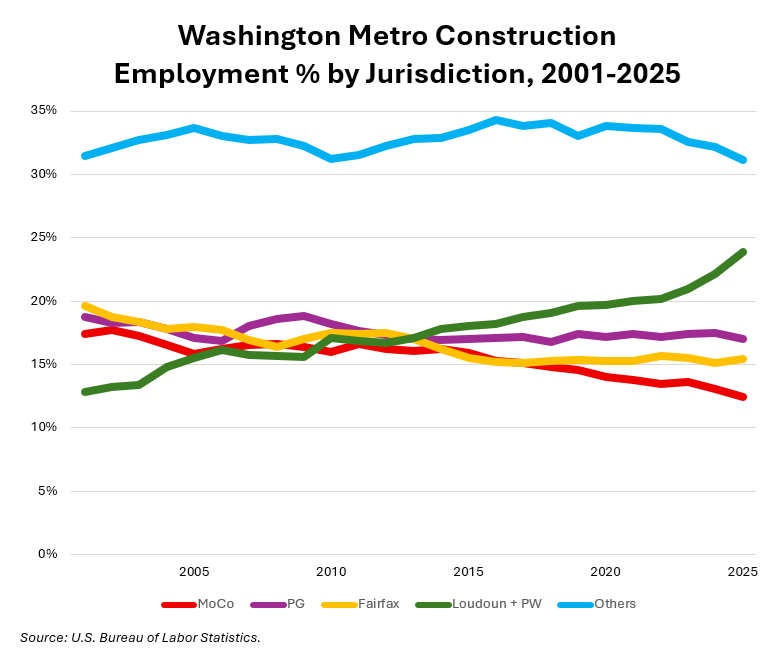
In 2001, MoCo construction employers accounted for 17.4% of payroll jobs. By 2025, they had slid to 12.4% of the region’s jobs. Fairfax employers were down too, from 19.6% to 15.5%. But the Loudoun/Prince William combination rose from 12.9% of payroll jobs to 23.9% over the period, with Loudoun construction employers hiring more workers than MoCo employers last year for the first time ever.
With the caveat that construction employers and workers frequently cross jurisdictional boundaries in mind, the data above reinforces the impression that economic growth has drifted away from MoCo (and perhaps Fairfax too) towards the Virginia exurbs. This is not a great sign for MoCo’s economy.
Next: establishments.