
By Adam Pagnucco.
Part One covered the methodology of this series. Part Two looked at total employment. Part Three examined federal government employment. Part Four reviewed private sector employment. Part Five looked at construction employment. Part Six examined establishments. Now let’s review real total wages paid.
The U.S. Bureau of Labor Statistics’ Quarterly Census of Employment and Wages (QCEW) program, upon which this series is based, defines wages this way:
Total compensation paid, including bonuses, stock options, severance pay, profit distributions, the cash value of meals and lodging, tips and other gratuities, and, in some states, employer contributions to certain deferred compensation plans (such as 401(k) plans), during the calendar quarter, regardless of when the services were performed.
Note that this does not include earnings of self-employed people. That is a growing part of the economy.
In this series, we use the Washington-Arlington-Alexandria CPI-W to convert nominal wages to 2025 real wages to adjust for inflation. This does not affect comparisons between jurisdictions since all of them are subject to the same inflation rate, but it does affect calculations of wage changes over time.
The chart below shows MoCo’s real total wages paid since 2001, the first year in this series.
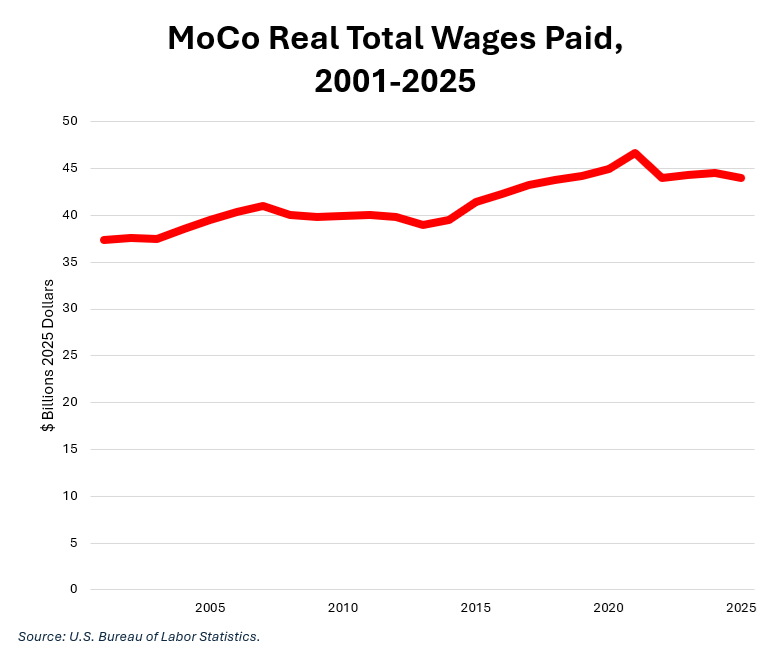
In viewing this chart, let’s bear in mind that it is impacted both by changes in nominal (pre-inflation) wages and price inflation. Overall, this stat grew in the pre-recession boom years, sank during the Great Recession, was stagnant through 2014 and then grew through 2021. It then declined with pandemic-era inflation and has not recovered since. That matters because wages are an important component of the county’s income tax revenue.
Now let’s look at growth in real total wages paid by jurisdiction last year.
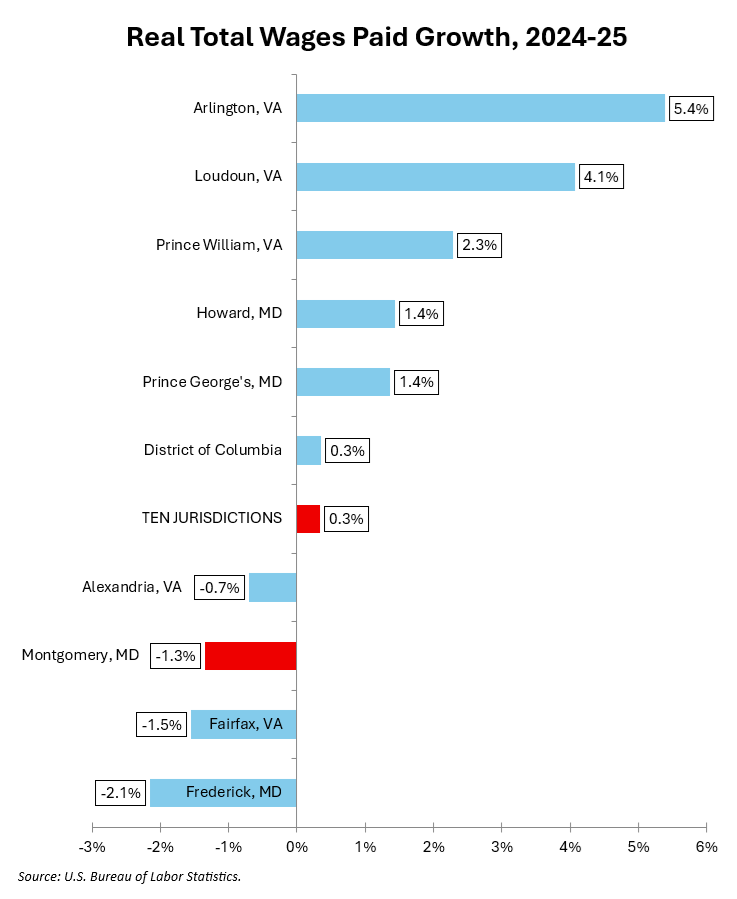
MoCo was one of four local jurisdictions in which real total wages declined. This was probably due in part to the county’s losses of total, federal government and private employment.
The chart below shows 2025 real total wages as a percentage of 2019 real total wages. It measures recovery in this stat from the pandemic.
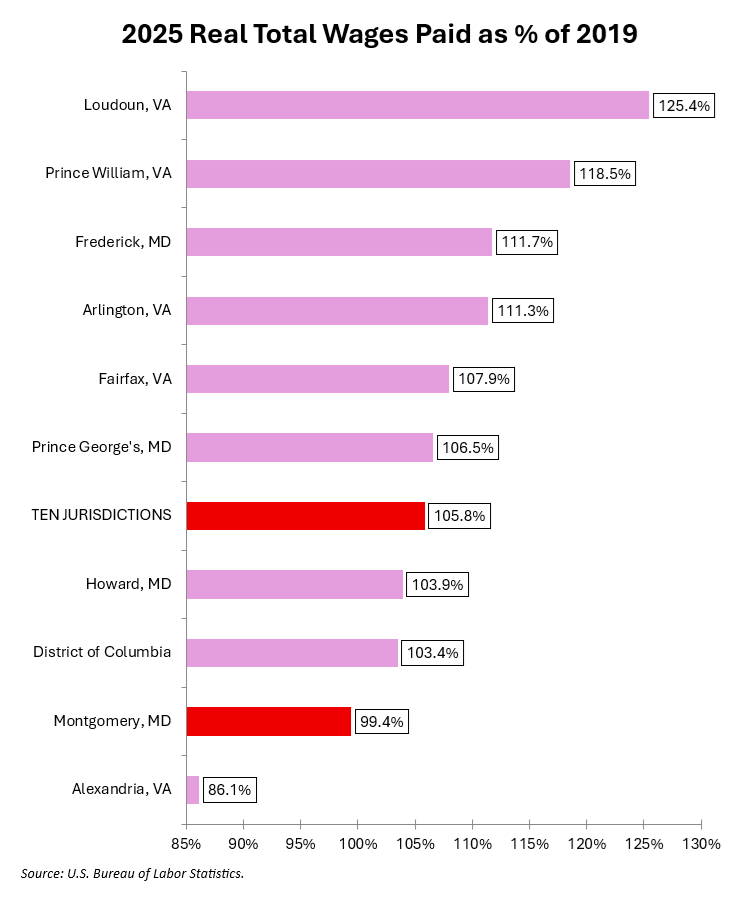
MoCo and Alexandria are the only two jurisdictions in which real total wages have not bounced back from the pandemic.
Finally, the chart below shows the change in real total wages paid from 2007, the year before the Great Recession, and 2025.
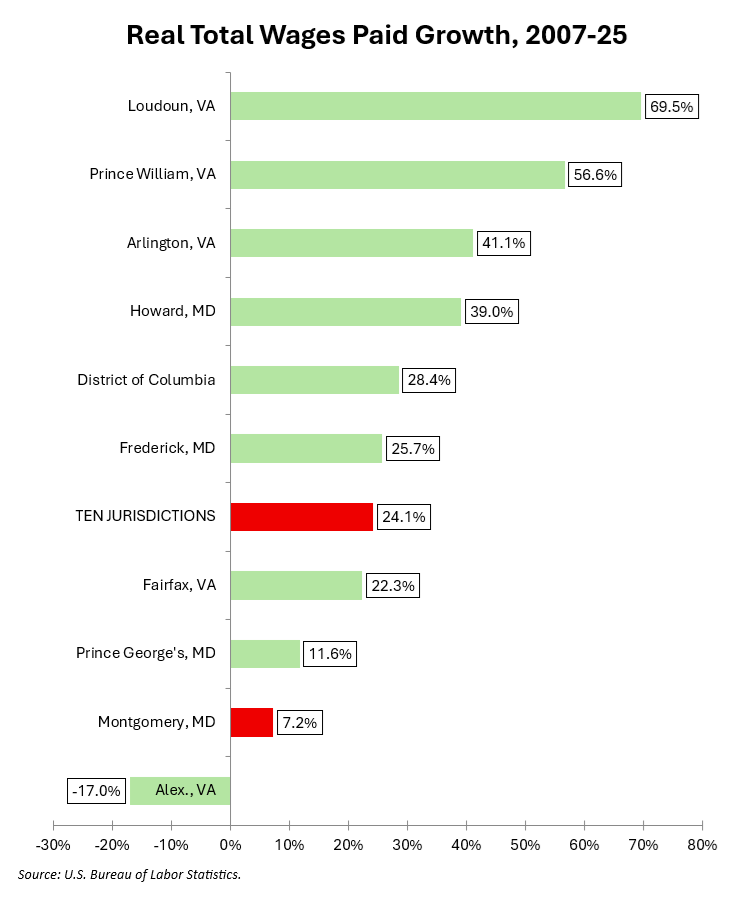
Again, we are second to last with only Alexandria trailing us.
This is a terrible long-term performance that limits our residents’ incomes and therefore the county’s income tax revenues. And since it spans two business cycles, it cannot be blamed solely on President Donald Trump.
Next: real total wages paid per job.