
By Adam Pagnucco.
Part One listed Will Jawando’s assets and liabilities. Part Two looked at Andrew Friedson. Part Three examined Evan Glass.
Before getting to the results, let’s review a brief timeline of key events in the election cycle.
2022: Council Members Evan Glass and Will Jawando finish first and second respectively in the Democratic council at-large primary, with each showing significant strength in their reelection campaigns. District 1 Council Member Andrew Friedson is reelected without opposition, enabling him to accumulate a growing campaign war chest for his next race.
2023: Jawando establishes his status as the county’s foremost champion of rent control, pushing the council to pass a strong bill. Glass voted for that bill while Friedson voted no. In a major debate over property taxes, Glass votes to increase them by 4.7%, Jawando votes no because he wanted a bigger tax increase and Friedson voted no because he thought a tax hike was unnecessary. Taxes and rent control helped define each candidate in the election three years later.
November 2024: Republican leader Reardon “Sully” Sullivan passes a charter amendment reducing consecutive term limits for the county executive from three to two, thereby preventing County Executive Marc Elrich from running for reelection. Glass, Jawando and Friedson soon begin preparing to run for executive.
March 2025: Glass announces for executive, the first of the three council members to enter the race.
May 2025: Jawando announces for executive.
June 2025: Friedson announces for executive.
August 2025: Council Member Kate Stewart announces that she is running for reelection to her District 4 seat. That was significant because she would have been a major contender for executive had she entered that race.
December 2025: Jawando receives the Apple Ballot, the number one endorsement in MoCo politics. This was the crown jewel in a growing treasure chest of progressive support that was organizing around Jawando.
January 2026: Campaign finance reports show Friedson opening a big fundraising lead over Glass and Jawando. Friedson would need that money as a district-based council member to build name recognition in the face of two experienced countywide rivals.
March 2026: The realtors endorse Friedson. Their funding of subsequent independent expenditures would become one of two major offsets to the Apple Ballot.
March 2026: Glass releases an internal poll claiming that he leads the executive race. This is the first of several polls showing that the race was within margins of error and was therefore competitive.
April 2026: Several groups begin to deploy Super PACs or independent expenditure committees in favor of Jawando or Friedson. I profiled the spending activities of these groups after the primary.
May 2026: The county council approves the abolition of the $692 Income Tax Offset Credit for homeowners. On a straw vote, Friedson, Glass and Jawando all vote no. But on the official vote, Glass and Jawando switch their votes to yes, thereby giving Friedson ammo for his mailers.
May 2026: The Affordable Maryland PAC, a Super PAC financed by the real estate industry, begins a $1.4 million independent expenditure campaign blasting Jawando. Later, they also target Glass.
June 2026: Governor Wes Moore endorses Jawando, an event that Jawando pollster Fred Yang later described as “critical.”
June 2026: The State Board of Elections announces that it is investigating Jawando for coordination with an outside group but clears Jawando a week later.
June 2026: Jawando enjoys a lead on election night that survives the later counting of mail ballots. This was the final result of the primary.
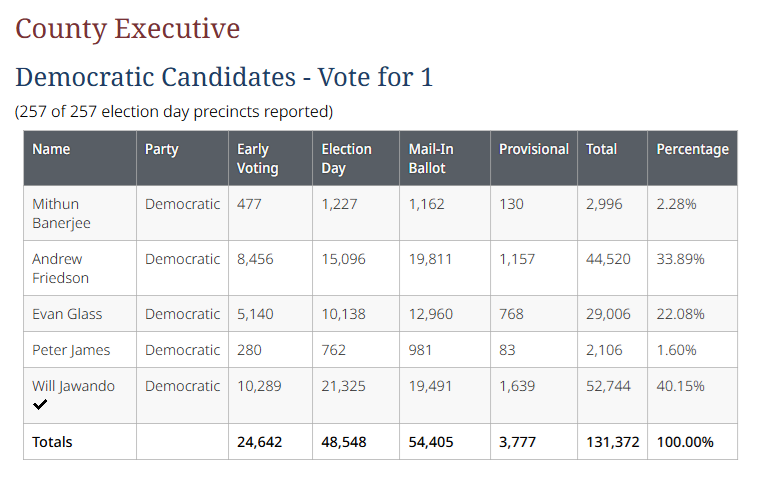
Jawando faces Republican Esther Wells in the general election, but since a Republican has not won a Montgomery County executive election since 1974 and Democrats comprise nearly 60% of the county’s voters, Jawando is heavily favored to occupy the second floor later this year.
Next: we get to the numbers.