
By Adam Pagnucco.
We have previously seen how the county’s disastrous experiment with rent control has caused a 96% collapse in multifamily residential permits, nearly destroying the county’s ability to create new rental housing. And now, as if that’s not bad enough, that crash in construction is damaging the county’s capital budget. One of the primary victims will be MCPS, which is asking for a huge capital budget increase.
New construction is relevant for the capital budget because the county government charges impact taxes on new projects designated to support infrastructure. There are two kinds of impact taxes: those levied to finance transportation spending and those levied to finance school construction. In better economic times, impact taxes have accounted for up to 15% of all the county’s transportation and school capital spending, a nice supplement to the county’s main capital revenue source (borrowing).
Yesterday, County Executive Marc Elrich released his new recommended FY27-32 capital budget. In his budget brief, Elrich had this to say about impact taxes.
*****
Impact Tax revenues, which support the capital budget, continue to decline due to policy choices made by the County Council and economic changes in the real estate market….
Footnote: Since the year 2020, the County Council has passed four bills resulting in reductions and deferrals in Impact Tax collections: Bills 38-20, 25-23E, 16-24, and 22-24E…
Impact Tax revenue projections continue dramatic write-downs for the third year in a row. For FY27-FY32, Impact Taxes are projected to decrease $61.5 million (36.3 percent) compared to prior approved estimates. In Fiscal Year 2014, the County collected $60.8 million in school and transportation Impact Taxes, compared to Fiscal Year 2025 collections totaling only $29.4 million, a reduction of $31.4 million or 51.6 percent. The Council continues to pass legislation eroding this important revenue source without first identifying a feasible replacement.
*****
When comparing the new capital budget to the previous iteration (FY25-30), transportation impact tax projections are down by 32% and school impact tax projections are down by 39%. That latter drop is a big deal for MCPS as school impact taxes have traditionally been one of the largest revenue sources for school construction.
If the projections in the new capital budget hold up, impact tax collections will now be at historically abysmal levels. The chart below shows impact tax receipts in the first two years of each capital budget going back to FY05. The amounts are expressed in 2025 real dollars using the Washington-Arlington-Alexandria CPI-U. Inflation for 2026-28 is assumed at 2.55%, which is the average of the ten prior years.

This chart says it all: adjusted for real dollars, projected impact taxes are expected to be at their lowest levels since the Great Recession.
That’s a challenge for both transportation and schools. The chart below shows the percentage of transportation and school spending accounted for by impact taxes in every capital budget since the FY05-10 amended budget.
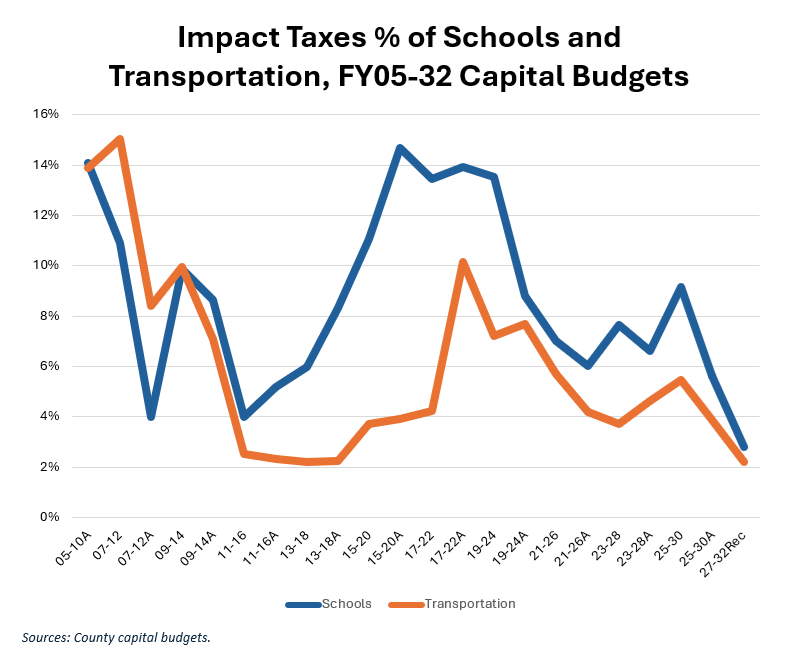
As you can see, in some past capital budgets, impact taxes collected from new development accounted for as much as 15% of transportation and school capital spending. Those days are long gone. In the newest capital budget, impact taxes are projected to account for 2.2% of transportation capital spending and 2.8% of school capital spending. Those are levels unseen since the Great Recession.
Elrich blames the evaporation of impact taxes on a series of tax abatement bills passed by the council to encourage new construction. But here’s the real story: new construction, at least in multifamily residential, has nearly disappeared because of rent control. We’re not building a lot of new construction projects right now, so we can’t tax them and apply the revenue to schools and transportation projects as we did in the past.
So what does Elrich want to do about this? He is a huge supporter of rent control and would never propose abolishing the law. In fact, he wants to tighten it to make it even more restrictive for property owners.
Instead, Elrich proposes two things.
First, he wants to borrow more money. His new capital budget includes $2.42 billion of general obligation bond revenues, up from $1.74 billion in the previous budget (an increase of 39%). Bond revenues are not free – they are paid off by debt service contained in the operating budget that competes with other forms of spending (like schools and public safety).
Second, his budget brief states this: “In March, I plan to introduce a Transportation Special Taxing District to allow us to accelerate projects that move the needle on our most critical transportation investments.”
You read that correctly. Rent control is impeding our ability to finance transportation projects because it’s killing new development, thereby destroying impact tax collections. So now our county executive will propose a tax increase to get the money instead.
As if there were any question remaining, this kind of leadership is why we are not competing successfully with Virginia.