
By Adam Pagnucco.
Part One covered the methodology of this series. Part Two looked at total employment. Part Three examined federal government employment. Part Four reviewed private sector employment. Part Five looked at construction employment. Now let’s examine establishments.
The U.S. Bureau of Labor Statistics’ Quarterly Census of Employment and Wages (QCEW) program, upon which this series is based, defines establishments this way:
Economic unit that produces goods or services, usually at a single physical location, and that is engaged in one or predominantly one type of economic activity.
Note: A single establishment generally produces a single good or provides a single service. An enterprise (a private firm, government agency, or nonprofit organization) can consist of a single establishment or multiple establishments. All establishments in an enterprise may be classified into one industry (e.g., a chain); into different industries (e.g., a conglomerate); or into an economic unit that produces goods or services, usually at a single physical location, and that is engaged in one or predominantly one activity (e.g., a factory, a mine, a store, or an office).
In the Washington region, 98% of all establishments are in the private sector, so effectively this stat is a proxy for place of business formation.
The chart below shows establishment counts in MoCo since 2001, the first year tracked by BLS for this series.
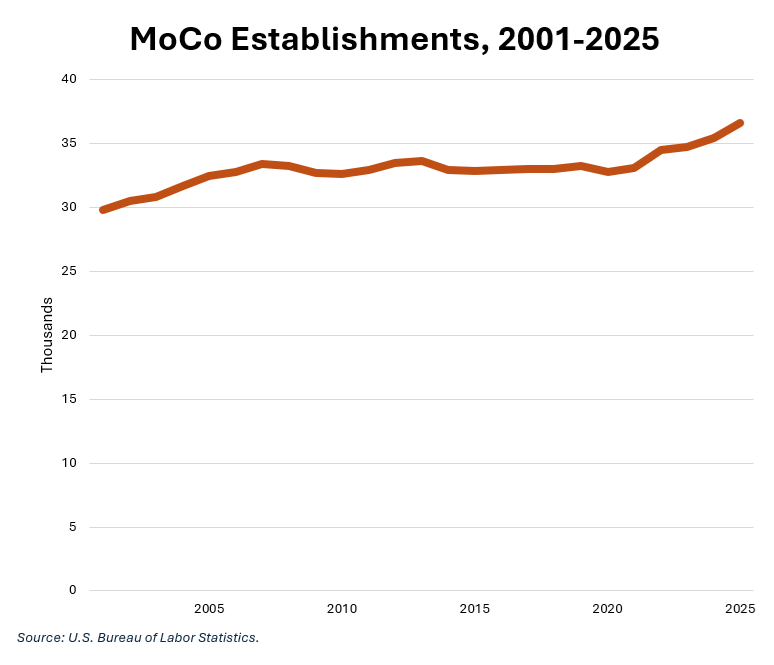
From 2007 through 2021, MoCo’s establishment count stagnated at around 33,000. But since then, it has been growing steadily.
Here is how establishments grew last year in each of the region’s ten largest jurisdictions.
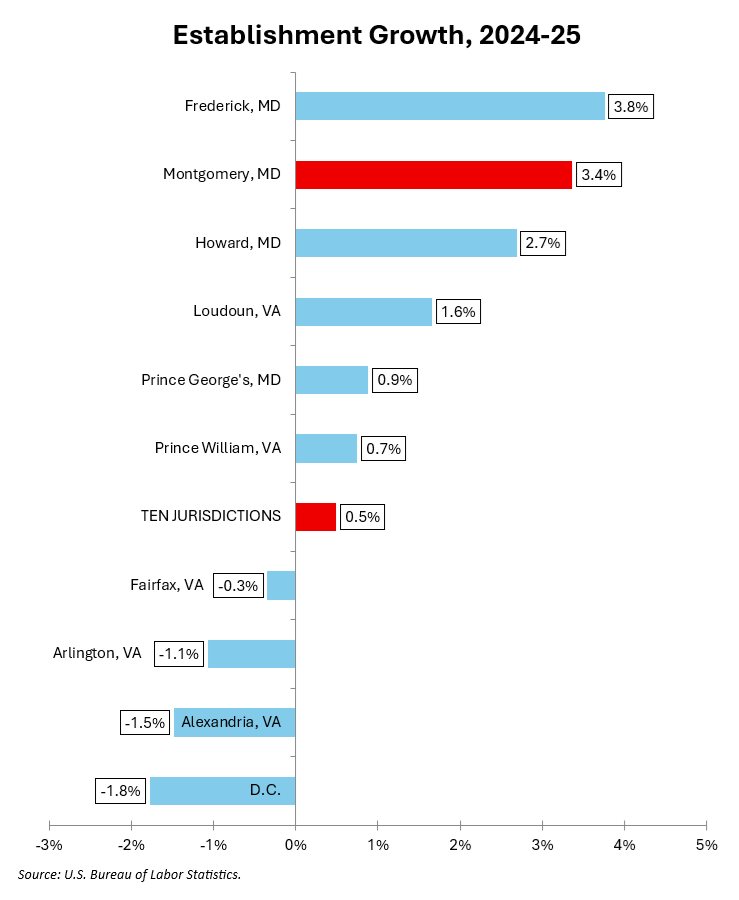
MoCo was one of the leaders on this stat last year, finishing second only to Frederick. This was one of the county’s bright spots in an otherwise difficult year.
The chart below shows 2025 establishments as a percentage of establishments in 2019. Essentially, it measures recovery in this measure since the pandemic.
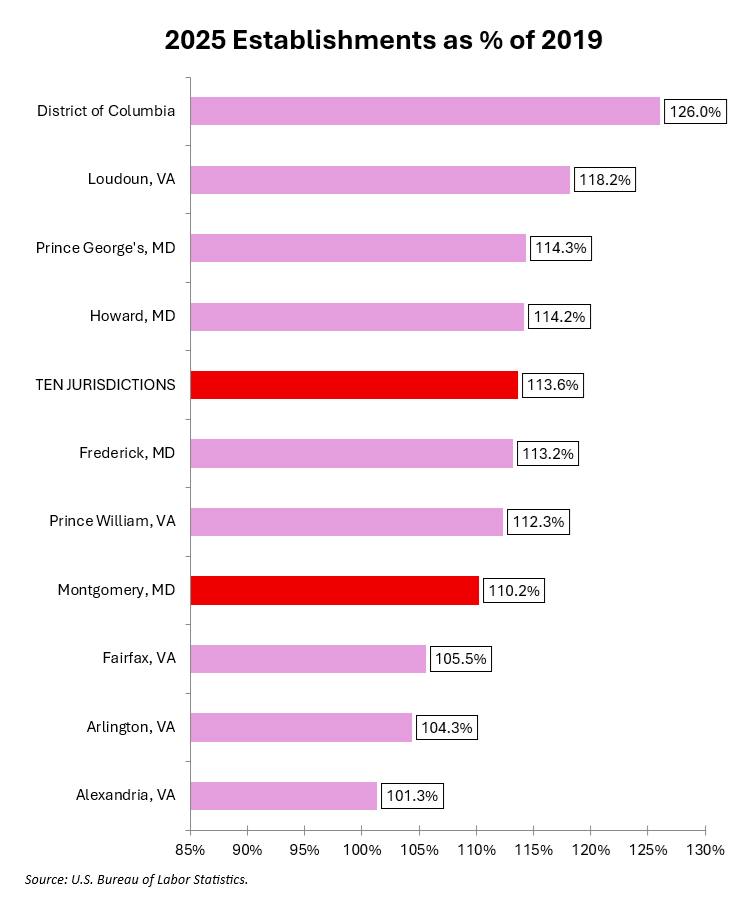
MoCo trailed the region average but not by much. Our performance since 2021 has helped us on this measure.
Finally, the chart below shows change in establishments from 2007 (the year before the Great Recession) through 2025.
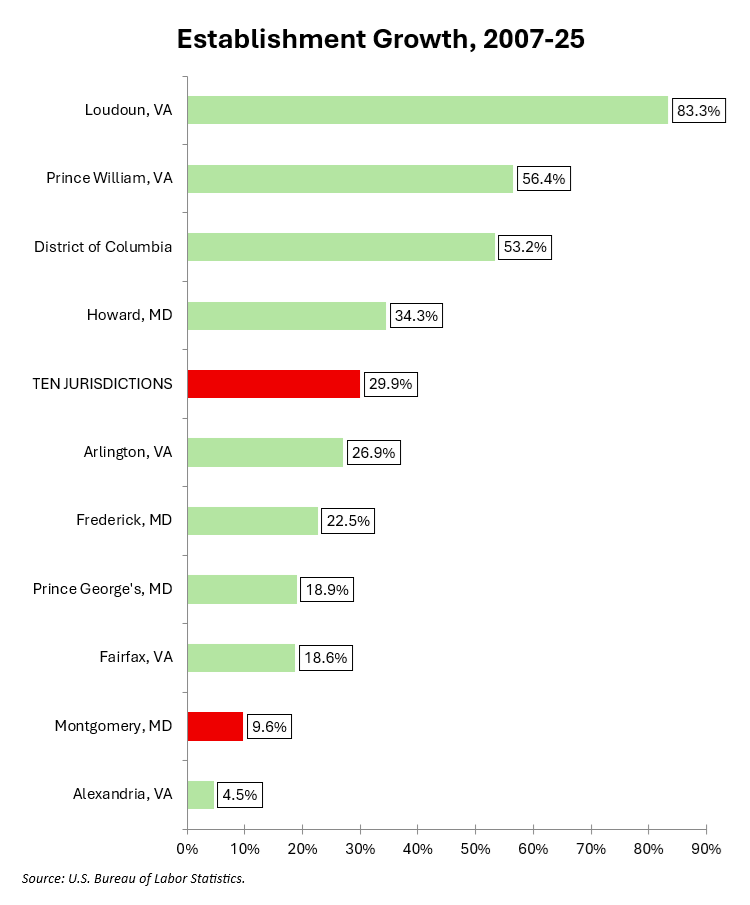
Over the long term, MoCo is still a laggard on this measure. Only Alexandria has done worse.
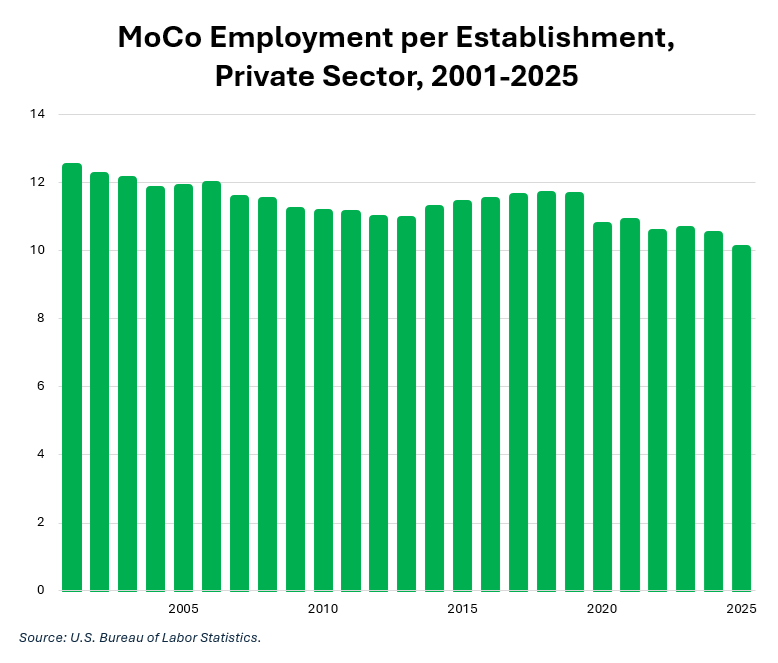
The combination of stagnant employment and recent growth in establishments has shrunk the average size of MoCo’s private sector establishments as shown in the chart below. This means the county’s employer base is increasingly reliant on small businesses. Policymakers should keep that in mind when considering taxes and regulations on the commercial sector.
Next: real total wages paid.