
By Adam Pagnucco.
So far, this summer has been a season of doom at MCPS. Confronted with the county council’s failure to fully fund the school board’s budget request, Superintendent Thomas Taylor pushed through cuts to hundreds of full-time equivalent (FTE) positions. Labor protested, with Montgomery County Education Association President David Stein proclaiming, “It is a really, really sad day, it’s a sad day for MCPS, it’s a sad day for Montgomery County.”
So is MCPS in trouble? Not really. By historical standards, its resources measure up pretty well – at least for now.
First of all, Taylor is understandably unhappy about getting less of his funding request than he wanted. All of his predecessors would agree. The chart below shows the percentage of the school board’s requested budget that was ultimately funded by the county council since FY08. Over the last twenty years, MCPS received full funding just five times.
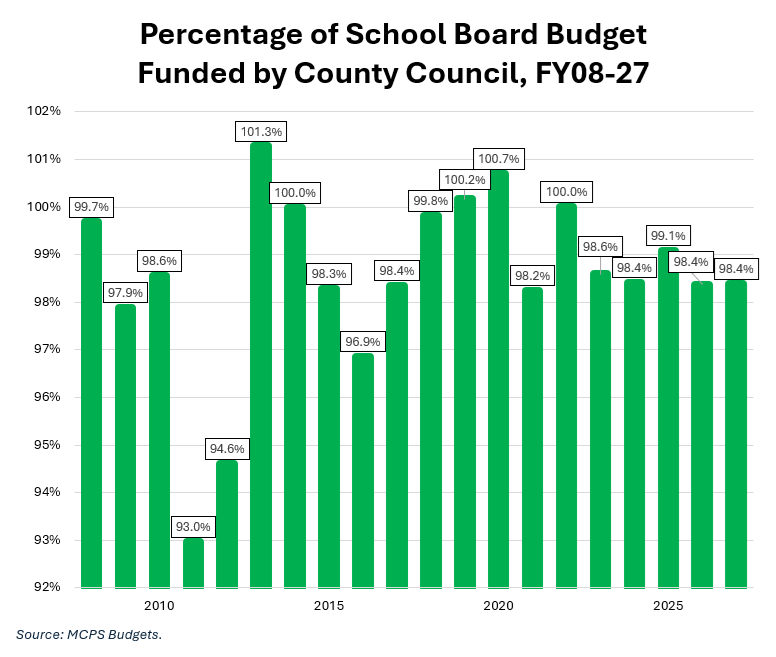
This year, MCPS received 98.4% of its request. That’s almost identical to the average 98.5% approval rate for the entire period shown above. Taylor is not confronting an unprecedented funding shortfall. That dubious honor belongs to former Superintendent Jerry Weast, who had to deal with actual dollar cuts during the Great Recession. Taylor’s experience is par for the course in recent MCPS history.
Second, while Taylor’s FTE package included a 415 position trim, that is relative to the school board’s request. Let’s remember that the school board wanted a total increase in positions despite MCPS’s falling enrollment. When compared with MCPS’s approved FY26 budget, its FTE count will be 236 positions lower. But when compared with its FTE count from the FY25 budget (24,448), MCPS’s FTE count this year (25,170) is 722 positions higher. Over that time period, MCPS lost 3,682 students.
That brings us to medium-term trends in staffing and enrollment. MCPS’s enrollment peaked at 165,267 in 2020, the first year of the pandemic. The chart below shows levels of enrollment and staffing (in FTEs) since that time.
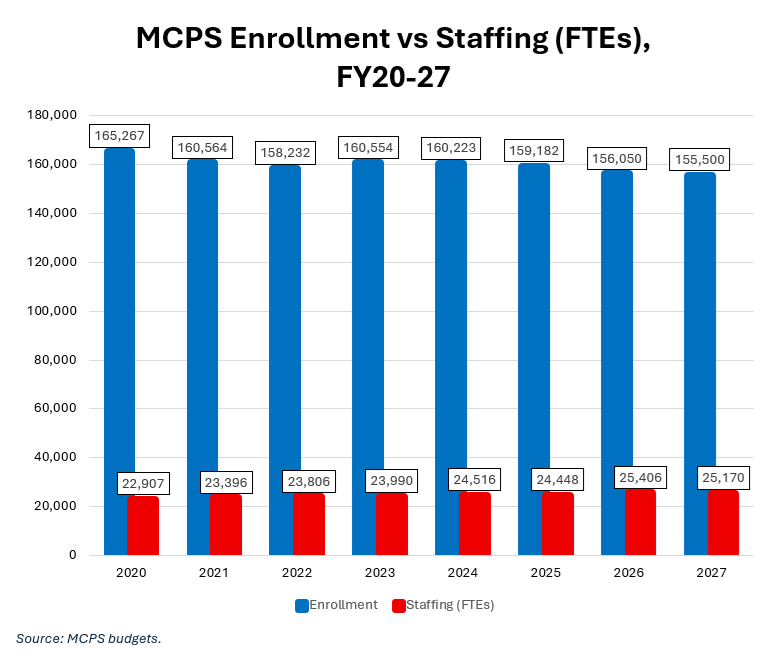
MCPS has lost enrollment in six of the last seven fiscal years. However, it has increased staffing in five of the last seven fiscal years. Over the FY20-27 period, enrollment is down by 6% while staffing is up by 10%. That includes this year’s position trim.
Here is another way of looking at it. MCPS’s FTE count per hundred students was 16.3 in FY26 and 16.2 in FY27. Over the FY06-20 period, MCPS averaged 14.3 FTEs per hundred students. Relative to its historical standard, MCPS is better staffed than at any other point over the last two decades.
That brings us to money. Over the FY20-27 period, while MCPS’s enrollment fell by 6%, its grand total operating budget grew by 41%. That’s a startling statistic, but it has a caveat: the pandemic saw a spike in inflation, which drove up costs at MCPS (and everywhere else).
To deal with inflation, I calculated grand total operating budget per student in 2027 dollars using the Washington-Arlington-Alexandria CPI-U. I estimated the CPI-U in 2026 using the rate of change over the first 6 months from 2025 (3.28%). I estimated the CPI-U in 2027 using the average rate of change over the prior ten years (2.77%). The chart below shows grand total operating budget per student in real 2027 dollars since FY05.
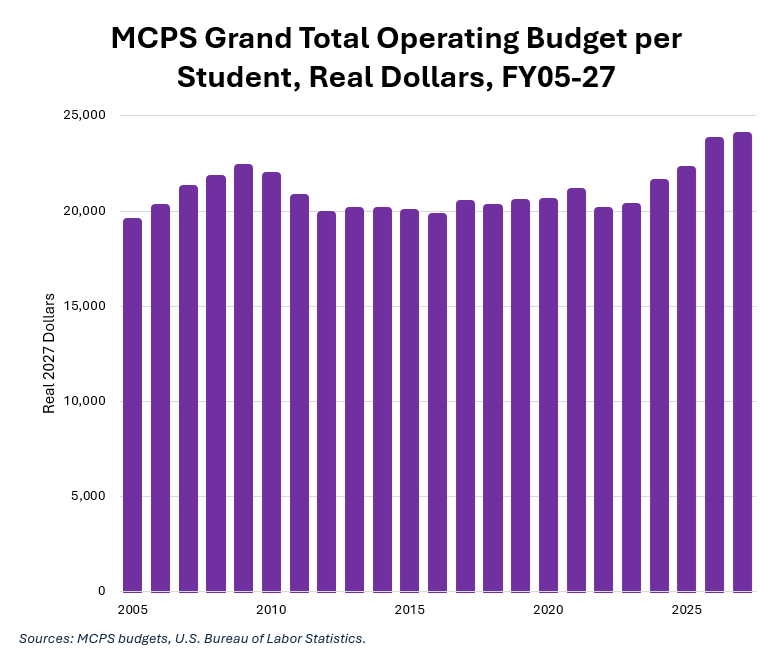
This stat has a complicated history since it summarizes three other stats: enrollment, total budget and inflation. It breaks down into three periods. During the pre-Great Recession real estate boom, fearsome MCPS Superintendent Jerry Weast pushed through big budget increases from a county budget overflowing with huge assessment increases. That ended when the Great Recession shut off the county’s real estate spigot and the council began to hold the line on per student spending. Real spending per student fell and then remained flat. The third era began during the pandemic, when falling enrollment combined with big county spending increases to spike real dollar spending per student. Consider this: in the five years from FY23 through FY27, the county council exceeded the state’s mandatory maintenance of effort minimum local appropriations for MCPS by a combined $801 million while enrollment fell. This was a windfall for MCPS.
So despite the apocalyptic winds blowing from Gude Drive, MCPS’s financial and staffing resources have done pretty well since the pandemic. Taylor has more money and staff per student, even when adjusting for inflation, than any of his five predecessors.
None of the above means that the county should stop all investment in the school district. MCPS has two inescapable needs. First, the system must recruit and retain employees – especially teachers – as working in public schools is as challenging as ever. That means competitive compensation packages, which are not cheap for a system that has more than 25,000 employees. Second, MCPS’s capital needs are undeniable. Two years ago, the school system estimated its infrastructure maintenance backlog at more than a billion dollars, which was double the amount it was in 2020. When it comes to infrastructure, you can pay for it now or you will pay a lot more for it if you wait until later. Failure to pay would condemn the system’s students and employees to intolerable facility conditions in which learning becomes difficult if not impossible.
That said, it is entirely reasonable for policy makers – and taxpayers – to expect that MCPS would adjust its staffing to recognize declining enrollment. That means an end to the rhetoric of apocalypse for the sake of getting the resources the school district genuinely needs.