
By Adam Pagnucco.
A new report from the Montgomery County Planning Department states that residential building permits in the second quarter of 2026 were “the lowest quarterly total in the 46 quarters stretching back to 2015,” which is the entire dataset in possession of the department. This is yet more evidence of the ruinous impact of rent control.
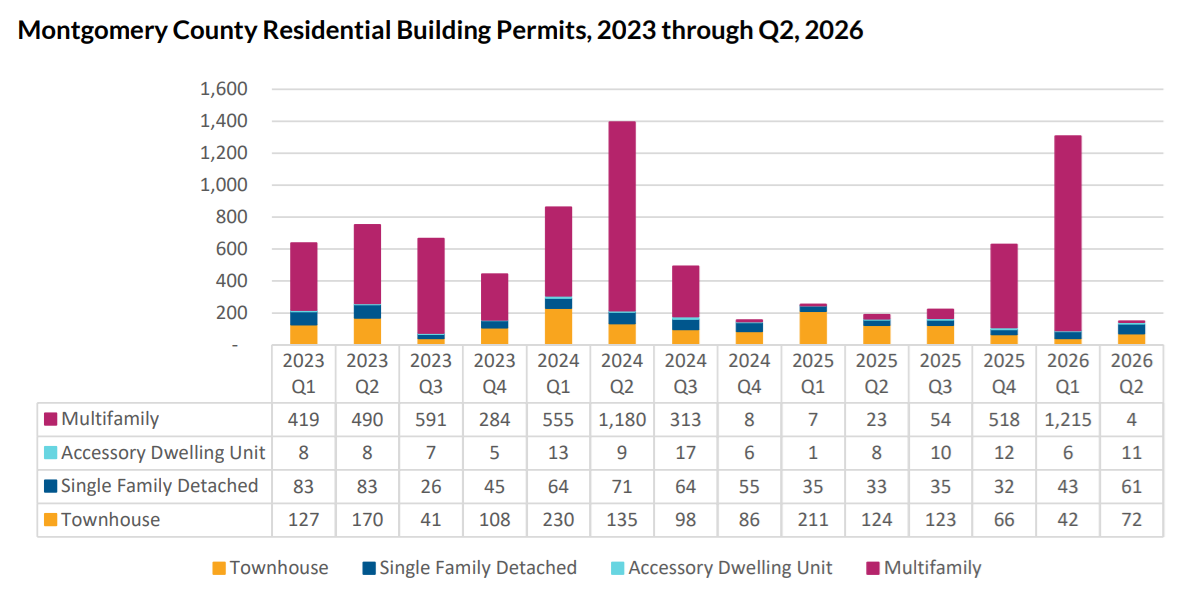
First, let’s show the data chart on permits by housing type in the department’s Q2 2026 Economic Indicators Briefing.
The department comments:
A total of only 148 new housing units were permitted in Q2 2026, according to data from the Montgomery Department of Permitting Services. This number is the lowest quarterly total in the 46 quarters stretching back to 2015, the period covered by the dataset. This total also included only four multifamily units, the lowest quarterly total of multifamily permits in this period.
The county’s rent control law took effect on July 23, 2024, during the third quarter. In the seven quarters through Q3 2024, multifamily permits averaged 547 units per quarter. In the seven quarters afterwards, multifamily permits averaged 261 units per quarter. That’s a decline of roughly half, but it has an asterisk.
Looking at the chart above, MoCo had a decent Q4 2025 and a good Q1 2026. Why? The January 2026 and May 2026 economic indicator reports list five multifamily projects in those quarters accounting for nearly all of the multifamily units permitted. Of these, four required tax abatements and/or public subsidies. Only one project was purely financed by the private sector. The other five quarters since rent control was established had minimal multifamily activity.
In the pre-rent control era, the private sector paid for most multifamily housing construction while public support aided a minority of projects. Today, the private real estate financing industry has mostly redlined the county while the reduced quantity of construction remaining relies heavily on many millions of dollars of tax abatements and public loans. We used to attract housing based on our inherent attributes as a market, but now our taxpayers must pay for it – and are getting less of it.
Later in the report, the department uses Census building permit data to contrast MoCo to our neighbors. After adjusting for jurisdiction size, the department writes, “Over the period from period from 2023 to the end of June, 2026, Montgomery County permitted 12 new units in 3+ unit buildings per thousand existing units, putting it behind Loudoun (27 per thousand), Arlington (24 per thousand), and Fairfax (18 per thousand) Counties in Virginia, Washington, DC (18 per thousand), and Frederick County, MD (13 per thousand).” And without taxpayer support, we would have fared worse.
Most economic conditions are characterized by conflicting indicators, with some pointing upwards and others pointing down. That’s not the case with multifamily housing construction in Montgomery County. As seen above, multifamily permits have declined sharply since rent control took effect. That has suppressed impact tax receipts for the capital budget. It has also blown a hole in the fee-driven budget for the Department of Permitting Services, which has raised permit fees by 15% to make up for the loss of multifamily permit revenues. The exodus of builders from the county has resulted in fee increases for those who still operate here. How does this facilitate housing construction?
MoCo has a desperate housing shortage and has set a target of building more than 65,000 units by 2050. It is now clear that we will never get there as long as the county’s rent control law continues to deter housing development.