
By Adam Pagnucco.
Imagine that you are a county council member facing the following situation.
The county’s economy has stagnated for two decades. The county had fewer payroll jobs in 2025 than it did before the Great Recession while most of the region surged ahead. It trails its neighbors on nearly every important economic indicator. The economic problems have been recently compounded by President Donald Trump, who has done his best to destroy federal employment and contracting during his second term.
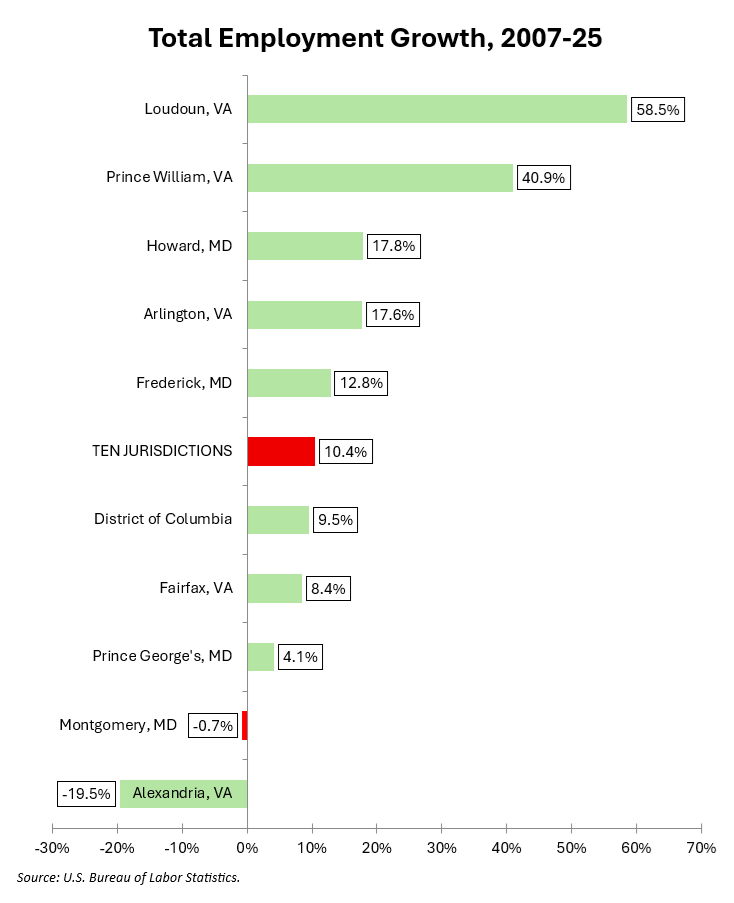
MoCo’s stagnant jobs base places it behind almost all of its competitors.
The economy’s weakness and Trump’s assaults have resulted in a huge revenue writedown. Even before that, revenue growth has trailed county employee compensation growth for six years in a row. The county is increasingly resorting to one-time gimmicks and band-aids to balance its operating budget like raiding the capital budget and diverting retiree health care money. Last year, that was not enough, so the county council repealed homeowners’ $692 Income Tax Offset Credit (ITOC), resulting in double digit increases in many homeowners’ property tax bills.
Want more? Last May, the county estimated that it had a structural deficit of $293 million. Its June fiscal plan projected that county agencies would have to take a combined $134 million cut to their operating budgets if FY28 revenue projections hold. The State of Maryland is preparing another major tax increase right after making MoCo pay almost half of the state’s income tax hike last year. The state will no doubt impose an array of cost shifts onto the counties too. Meanwhile, MCPS faces a $97 million health care hole – a figure that does not include county government – and county agencies confront more than a half billion dollars of annual deferred maintenance on schools, parks and transportation facilities.
It’s a tough picture. So how would you react? I imagine you might have quite a few ideas, but here is the one appearing on the county council’s agenda tomorrow: creating tens of millions of dollars in new entitlements.
I have previously written about the council’s MCPS tax credit bill, which would give many county homeowners employed by MPCS a $2,500 property tax credit right after the council repealed the $692 tax credit received by most other county homeowners. The bill’s fiscal impact is currently projected at $20-23 million a year. The council is due to vote on this bill tomorrow. Another $500 supplemental tax credit for some families with children, also on the agenda, would cost more than $6 million a year. All of this money will be added to the county’s structural deficit.
Ironically, right before the council votes on these bills, it will receive a briefing titled Strategizing for Future Budgets. The briefing documents contain spending wish lists from county unions, chambers of commerce and nonprofits cumulatively totaling uncounted millions of dollars. But here’s the thing: a lot of this spending has merit. Of course we need to adequately fund MCPS. Of course we need to fund nonprofits serving county communities who need help. And of course we need to fund economic development activities.
But we can’t do everything all at the same time.
Luckily, there is a long-established vehicle that the council can use to make funding decisions: the annual budget process, which occurs every spring. Why not table the tax credit bills, reintroduce them in the spring and have them compete with everything else on the council’s reconciliation list? That way, the needs of all the county agencies, both operating and capital expenditures, can be weighed against tax credits and everything else worthy of consideration. And if there’s not enough money for everything, well, the council must figure out the appropriate balance between these priorities. That’s one of the most important functions of being an elected official.
The creation of tens of millions of dollars in new entitlements while a hulking structural deficit looms is a path to fiscal ruin. But the consideration of all priorities together in the face of a full revenue picture is a path to balance. With residents’ increasingly stretched wallets on the line, which path will the council choose tomorrow?