
By Adam Pagnucco.
I was a chief of staff at the county council from 2010 through 2014. Here is one thing I noticed about county government: there was a ton of people who thought it was their job to say NO.
They were everywhere. They seemed to pervade management and many of them held positions of real power. Whenever I (or others) identified a problem and proposed a way to fix it, these folks would say NO. I would ask why. Typically, the answer had two dimensions to it. First, the problem wasn’t really a problem because the data was wrong, or somewhere out there maybe there was data saying otherwise. (They didn’t actually produce this contrary data but they did say it existed… somewhere.) Second, we were the leaders, the best. Why? Because we were Montgomery County and some county government association had given us awards. Why were we doing things a certain way? Because we had done them for twenty years and we had not collapsed. There is no problem, regardless of what any data says, so we are going to say NO.
It’s a culture of denial.
And it’s not just inside the county bureaucracy. It pervades our political culture.
Rent control provides one example. It’s an epic failure. It has accomplished something that no NIMBY activists or politicians ever could, despite decades of trying: it has shut down private sector multifamily housing production. The vast majority of new multifamily construction that remains requires heavy public subsidies. So taxpayers are paying more, getting less housing in return and will now suffer the effects of a permanent housing shortage. Want more? Look at how rent control damaged the county’s capital budget revenues just as MCPS requested a huge increase.
The evidence about the damage inflicted by rent control laws from our county planning department, from the experience of rent control in Takoma Park, from the experience of rent control in St. Paul, Minnesota, from the last time that the county had rent control in the 1970s, from the county council’s own staff and from an avalanche of economic literature is undeniable to anyone capable of critical thinking.
But no amount of evidence can bust through the wall erected by our culture of denial. County leaders defend rent control mostly on the grounds that property owners are complying with it. It’s a comical defense because it could be used to justify almost any law regardless of its effects, good or bad. They dismiss its impact on housing supply out of hand. Council Member Natali Fani-Gonzalez, who used to be a planning board member, even told the Banner: “Anybody that comes to me telling me that rent stabilization is the reason why we don’t have development applications coming in — let me tell you, you don’t know how to read.” Has she read any of the work produced by her own county’s planning department?
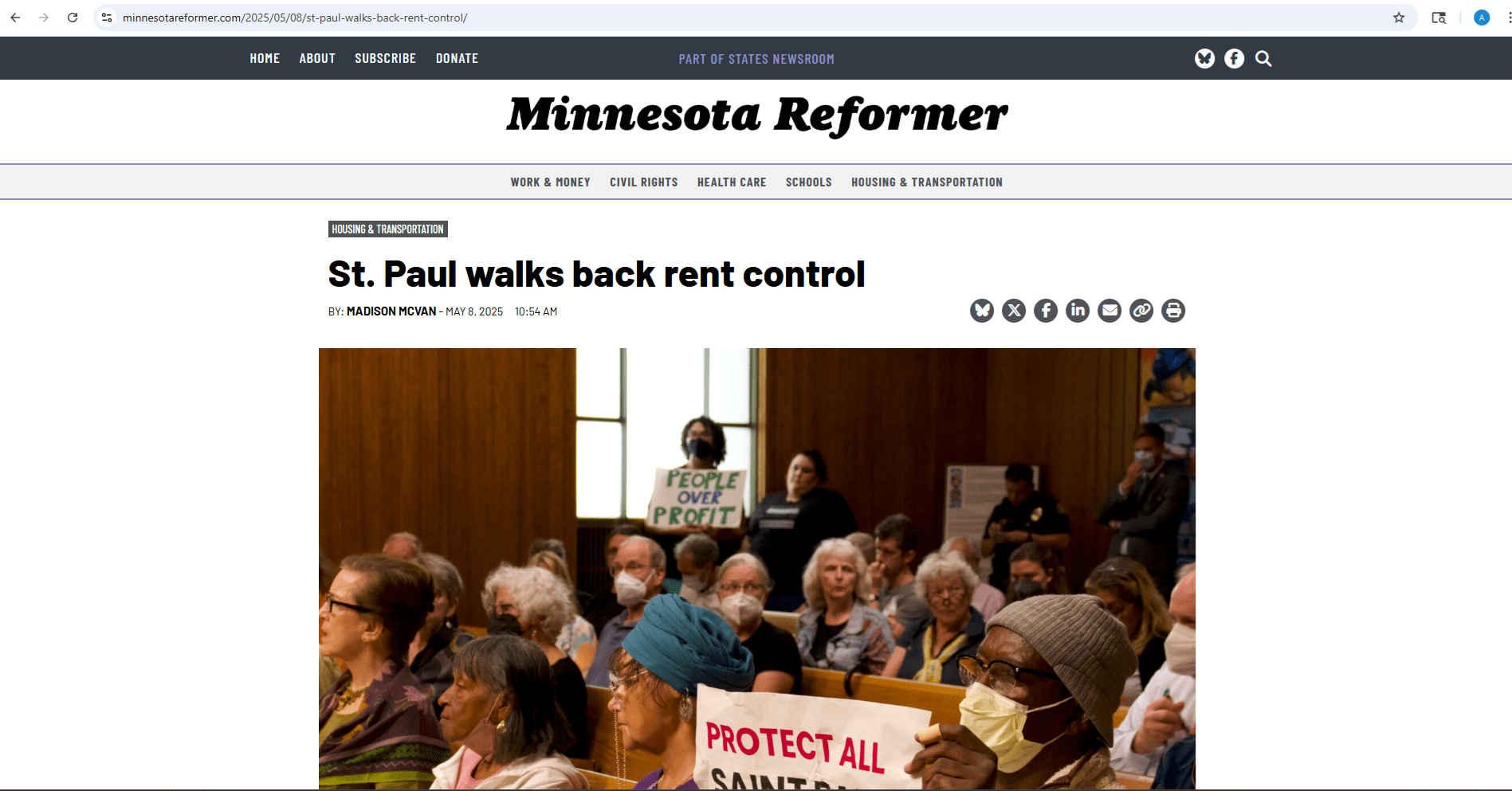
St. Paul is learning painful lessons about rent control. Are we?
Rent control is just one issue. After all, if a county isn’t producing housing and isn’t producing jobs, we can still survive, right? (It’s a rhetorical question, folks.) Just look at the big picture. For many years, we have failed to keep pace with the rest of the region economically. That has now produced an awful situation in which we may no longer be able to pay for the escalating cost of things we need (like school construction) without tax increases.
This has been a long time coming. In 2010, a report by the county council’s Office of Legislative Oversight compared MoCo to Fairfax County and found this: “Between 2002-2007, the number of jobs increased by 14% in Fairfax County and 8% in Montgomery County.” The report included the stunning employment chart reprinted below.

I was writing about our lack of competitiveness as far back as 2016 and 2017 and I wrote a five-part series on taxpayer flight in 2018. That same year, Sage Policy Group wrote a 42-page report on how we were failing to keep up.
Fast forward to today. Nothing has changed and now our ability to pay our bills – for schools, for public safety, for social services, for everything – is in big trouble. As a result, funding for the progressive priorities our leaders profess to support is now endangered. More tax increases leading to more taxpayer flight risks making our problems permanent.
I am not a nihilist. Our problems are fixable. What is required is a culture of problem solving. We identify a problem. We understand its risks. We do research on how other jurisdictions have fixed similar problems. We develop a plan to fix it. We implement it.
This might mean that we avoid doing certain things. For example, if we spend more money to fix X, we might have to spend less money on Y. If a politically popular “solution” risks making a problem we want to fix even worse, we don’t do it regardless of what interest group wants it. Progress requires discipline, and discipline requires character. And all of this requires courage.
I get it. It’s hard. It can be politically difficult. But to the county’s elected officials: no one forced you to take your jobs. You wanted them. You have them. So do them right, put on your big boy pants and do two things: fix the problems we have and don’t create new problems (like rent control).
This can be done, but not while our leaders embrace their longstanding culture of denial. Obviously, most of the ones we have now won’t break out from that culture.
There is only one thing that can make them do that.
You. The voters.