
By Adam Pagnucco.
Most county races rely on mail, digital and field programs. The exception is the county executive race, in which top-level candidates draw on seven-figure budgets and expand their comms to include TV. This activity can be measured using the Federal Communications Commission’s political ad files.
First, a few comments. This data is awful! It’s contained in gobbledy-gooky pdf files. It requires hours of data entry. It does not contain information on ad production costs. And it does not measure spending on connected (Internet) TV or streaming platforms. Those media operations are outside the FCC’s jurisdiction and have a growing role in political spending. So while the FCC data is interesting, it’s incomplete.
Caveats aside, I assembled gross amounts of TV contract spending for these outlets: Comcast of Potomac, WDCA, WJLA-TV, WRC-TV, WTTG and WUSA. These are the biggest TV operations covering Montgomery County. The chart below shows the gross amounts spent by Council Members Andrew Friedson, Evan Glass and Will Jawando on the above outlets.

Friedson spent more than a million dollars on these outlets, followed by Glass and then Jawando. That’s no surprise given Friedson’s huge edge in fundraising. But that’s not all that can be learned from this data.
The TV contracts specify the days they cover. That enabled me to calculate TV spending by day through June 22, which is shown in the chart below.
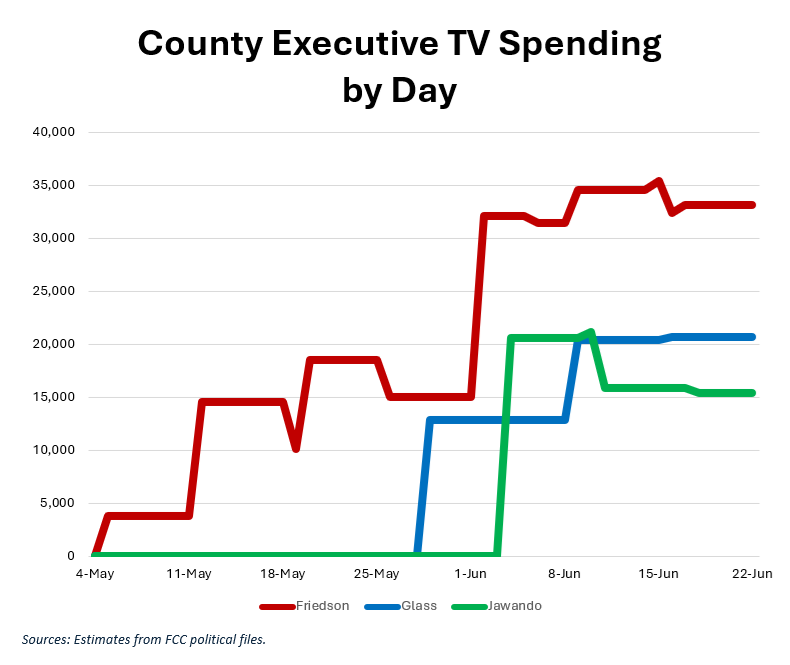
Friedson began spending on May 5. Glass joined in on May 29, followed by Jawando on June 4. That means Friedson had the airwaves to himself for more than three weeks.
For four days (May 29 through June 1), Glass came close to parity with Friedson. But starting on June 2, Friedson started spending more than $30,000 per day through June 22. His rivals could not keep up. Jawando peaked in the June 4-10 period but then fell off a bit. This makes me wonder if Jawando’s burn rate during the campaign’s early stages, which was significantly higher than Glass’s, has prevented him from sustaining his TV program. Don’t spend early folks, or you will wind up like Brandy Brooks!
One more factor can’t be measured from this data. Unlike in prior cycles, the FCC site no longer supplies reliable spending estimates for non-federal independent entities. That means I can’t include the Affordable Maryland PAC in the above presentation. The PAC’s filings with the State Board of Elections show that it has spent more than $1.6 million on TV, a figure likely including production costs. That means this PAC is probably number one in TV spending and has spent significantly more than Glass and Jawando spent combined. Its negative ads have definitely affected this race, although their magnitude of impact is debatable.
Finally, MoCo executive candidates have not had the airwaves to themselves. D.C. just had local races and CD6 has attracted huge ad buys, especially by the free-spending David Trone. (After the 2024 U.S. Senate race, I promised myself I would never try to track Trone’s TV spending again!) All of that extra political noise has competed with our candidates and may have buried any small spending amounts.
We shall see what impact this has had once the votes have been counted.