
By Adam Pagnucco.
Part One listed Will Jawando’s assets and liabilities. Part Two looked at Andrew Friedson. Part Three examined Evan Glass. Part Four recited a timeline of key events in the election cycle. Parts Five and Six broke down Jawando’s performance. Parts Seven and Eight looked at Friedson’s performance. Part Nine reviewed Glass’s performance. Now let’s review one of Glass’s primary assets: his election run in 2022.
Four years ago, Council Member Evan Glass posted a historically great performance in the council at-large Democratic primary. Four years before that, Council Member Hans Riemer was the runaway leader in the 2018 council at-large Democratic primary. Each of them would run for county executive in the following election and finish third in the primary.
So how much do council at-large performances matter in an executive race?
In considering that question, let’s consider the inherent difference between those two races. An executive race is a vote-for-one contest. Each voter gets to make one selection and that’s it. (In ranked choice voting, voters also get to make second and potentially other choices if their first choice candidate loses, but that’s a whole other conversation.)
In the council at-large race, voters can cast up to four votes, each for one of the four at-large seats. Back in 2022, I described it this way:
*****
Council at-large races are unusual in that they involve multiple seats and are most similar to state delegate races. The person who best described the dynamic of such elections to me was then-26-year-old Jeff Waldstreicher, who was running for delegate in District 18 in 2006. I will paraphrase his take on how they work:
There are three seats at stake. I tell voters that I don’t have to be their first choice, although that would be great. I don’t even have to be their second choice. I just want to be one of their top three choices. A vote is a vote and they all count equally.
Henceforth, this shall be known as the Waldstreicher Doctrine.
*****
And so candidates can rack up a ton of votes without necessarily being the first choice of many voters. For example, in the council at-large race, a candidate who is the fourth choice of every single voter would at least tie for first place. The intensity of voter support is not very important. As Waldstreicher said, a vote is a vote and they all count equally.
I could see a preview of this dynamic between Glass and one of his executive competitors, at-large Council Member Will Jawando, when I analyzed cast vote data from 2022. Glass finished first in that race and Jawando finished second. However, in terms of bullet voting – folks voting for only one candidate – Jawando did almost twice as well as Glass. This suggested that the intensity of Jawando’s support exceeded Glass’s, but since the number of bullet votes was small compared to total voting, it was not proof.
When at-large candidates run in one seat races, they are no longer in an election in which they can share voters with other candidates. Each of those voters must pick one. Only the top choice gets a vote. That means some voters who supported the at-large candidate as a second, third or fourth choice will wind up supporting someone else. A falloff in voting is inevitable.
Since 2002, six candidates ran in Democratic primaries for an at-large council seat and then ran in a Democratic primary for executive four years later. The table below shows how many votes they received in the at-large election, how many votes they received in the following county executive election and what percentage of their at-large votes they lost.
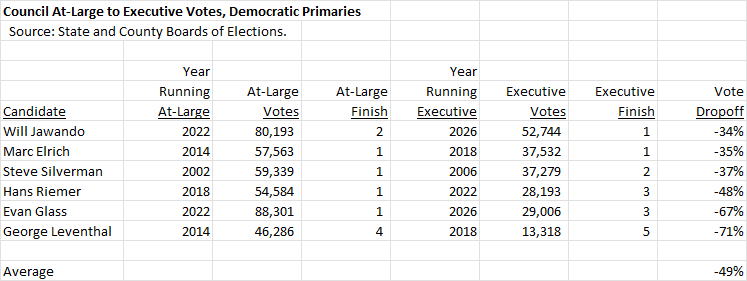
The two candidates who suffered the least dropoff in votes – Jawando and Marc Elrich (in 2018) – were both elected. The others were not. Glass lost a bigger percentage of his votes than anyone other than George Leventhal in 2018, and it was close.
First-place at-large finishers don’t always win. Elrich finished first in the 2014 at-large race and barely became executive four years later. Glass and Riemer finished first at-large and then finished third for executive four years later. Steve Silverman finished first in the 2002 at-large race and was beaten by former at-large Council Member Ike Leggett for executive by 26 points in 2006.
Finally, consider this. According to 2022 cast vote records, 53,279 Democratic voters voted for both Glass AND Jawando in the at-large primary. That means a majority of Glass voters also supported Jawando and vice versa. Forced to choose between them for county executive, the 2026 primary result suggests that most of them picked Jawando. That’s despite the fact that Glass led in total votes four years ago.
Council at-large voting does matter because it gets candidates on the ballot countywide, thereby building name recognition, relationships and campaign experience. But history shows that a strong performance in a council at-large race does not guarantee a county executive win.