
By Adam Pagnucco.
Outrage about the county’s recent huge tax hike on most homeowners has been swirling on social media for weeks. And in the many discussions on this topic, one question keeps coming up: did county leaders make any budget cuts before increasing taxes?
The answer is kind of. Why do I say that?
First, let’s review the county’s budget process. The county has two budgets: a capital budget and an operating budget. Each year, the county executive recommends a capital budget in January and an operating budget in March. The county council then changes and approves those budgets before a new fiscal year begins on July 1. The council’s authority is broad but not unlimited as it is constrained by state mandates, most notably by maintenance of effort requirements for MCPS and Montgomery College. It must also fund debt service on bonds for capital spending that were previously issued.
Each spring, the council goes through an intense process of reviewing and changing the executive’s budgets. In a prior post, I described what that’s like. At the end, the council’s approved budgets are published and can be evaluated against the executive’s recommended budgets. That’s how you can detect the changes made by the council.
Let’s look at the FY27 total operating budget. The executive recommended $8.019 billion in operating spending, an increase of $388 million (5.1%) over FY26. The council approved $7.935 billion in operating spending, an increase of $303 million (4.0%) over FY26.
This is not a cut. The council approved a lower rate of increase in spending than the executive wanted. That’s because its net tax increase on homeowners raised less revenue than the executive’s recommended rate increases in property and income taxes. It’s also a rather minor change because the difference in dollar increase between the two ($85 million) is just 1.1% of the FY26 operating budget.
Now let’s examine the differences between the executive and the council in funding by large department and agency. The chart below shows the percentage trims made by the council to the executive’s budget for all departments and agencies with at least $30 million in funding in FY26. Negative values are net additions. Note that in the vast majority of instances, these trims are not actual cuts but are instead smaller increases than the executive wanted. The only large departments that received less money in FY27 than they received in FY26 are Housing and Community Affairs (down 7.7%), Environmental Protection (down 4.4%), Technology and Enterprise Business Solutions (down 1.5%) and Montgomery College (down 0.02%).
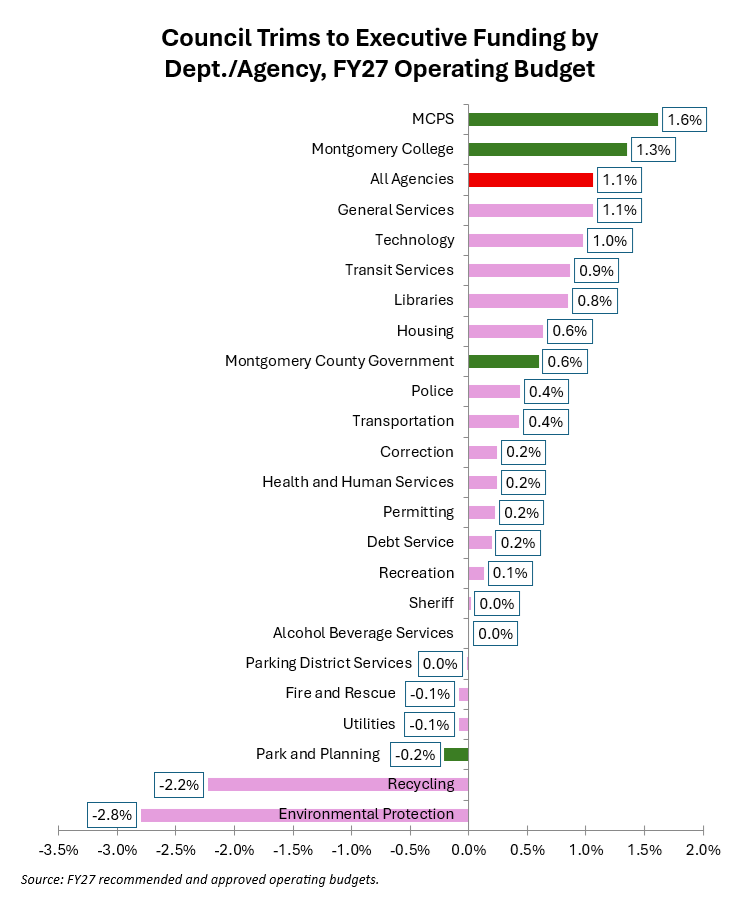
MCPS stakeholders are sure to note its top ranking on this list. What happened to the school district? The executive recommended $3.785 billion for MCPS in FY27, an increase of $190 million (5.3%). The council approved $3.724 billion for MCPS in FY27, an increase of $129 million (3.6%). This was not an absolute dollar cut but rather a smaller increase than the school system was seeking. MCPS responded by cutting hundreds of positions.
Was MCPS unfairly victimized by the council? I’ll make the case for and against.
Yes, it was unfair
Consider this stat. The council trimmed $85 million from the executive’s recommendation. $61 million (72%) came from MCPS despite the fact that MCPS accounted for just 47% of the FY26 operating budget. Additionally, the council diverted money from MCPS’s capital budget to fund its operating request – an ill-advised one-time maneuver – despite the system’s undeniable facility needs. If I were MCPS management or its powerful employee unions, I would be hopping mad at such targeting.
No, it was fair
Despite the disparate treatment this year, MCPS has received several years of robust operating budget increases despite falling enrollment since the pandemic. As I have previously written, “Over the FY20-27 period, while MCPS’s enrollment fell by 6%, its grand total operating budget grew by 41%.” Currently, its inflation-adjusted funding and staffing per student are near record highs. Additionally, the state’s maintenance of effort mandate locks in a lot of that spending and potentially exposes other agencies to disproportionate cuts if (when) another recession hits. So if they were so inclined, the council members could argue that MCPS has done pretty well for several years even if it did not get everything it wanted this year.
I leave it to you to decide which argument has more merit.
Now the big picture. The council went through an excruciating budget last spring but chose not to substantially change the spending in the executive’s budget. That’s why it revoked the $692 Income Tax Offset Credit received by most homeowners despite significant recent increases in property assessments. Now the incoming executive and council face real spending cuts next year – not lower increases, but actual cuts – if current fiscal projections hold. Will they change course on spending? Or will this year’s big homeowner tax increase prove to be a harbinger of more tax hikes to come?