
By Adam Pagnucco.
Part One examined long-term trends in registration and gubernatorial primary turnout rate by party. Part Two looked at the geography of Democratic turnout in this year’s primary. Part Three began examining race and included charts on Dem turnout rate by Asian and Black precinct population percentage. Part Four looked at charts on Dem turnout rate by Latino and White precinct population as well as mean zip code household income. Part Five used correlation coefficients to further understand these variables. Today, we examine voting modes.
The State of Maryland provides four ways to vote: mail, early voting, election day voting and provisional voting. The chart below shows utilization of those modes in the 2022 and 2026 MoCo Dem primaries.
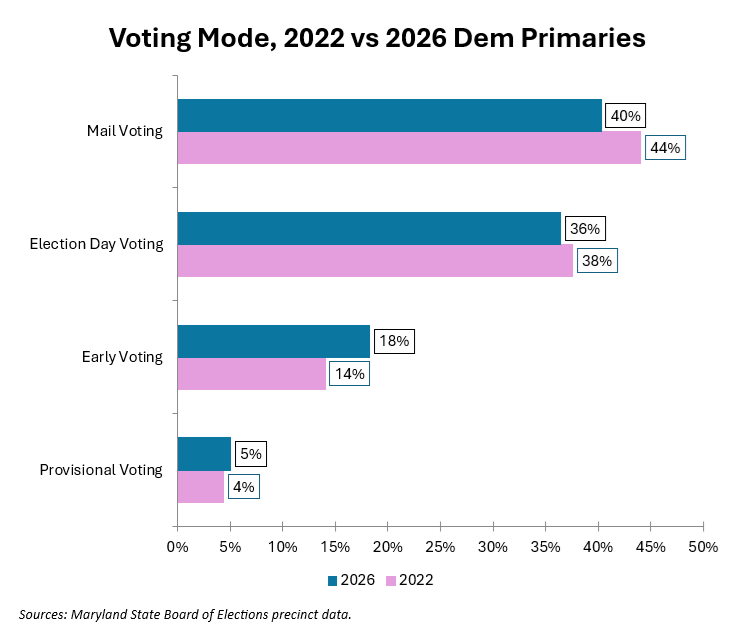
Mail was the plurality voting mode both last time and this time. That’s why campaigns stretch out their mass comms seasons much more so now than before the pandemic and the institution of early voting.
The chart below shows percentages of mail, election day and early voting in this year’s Dem primary in the precincts with the highest population concentrations of the four major racial groups (Asian, Black, Latino and White).
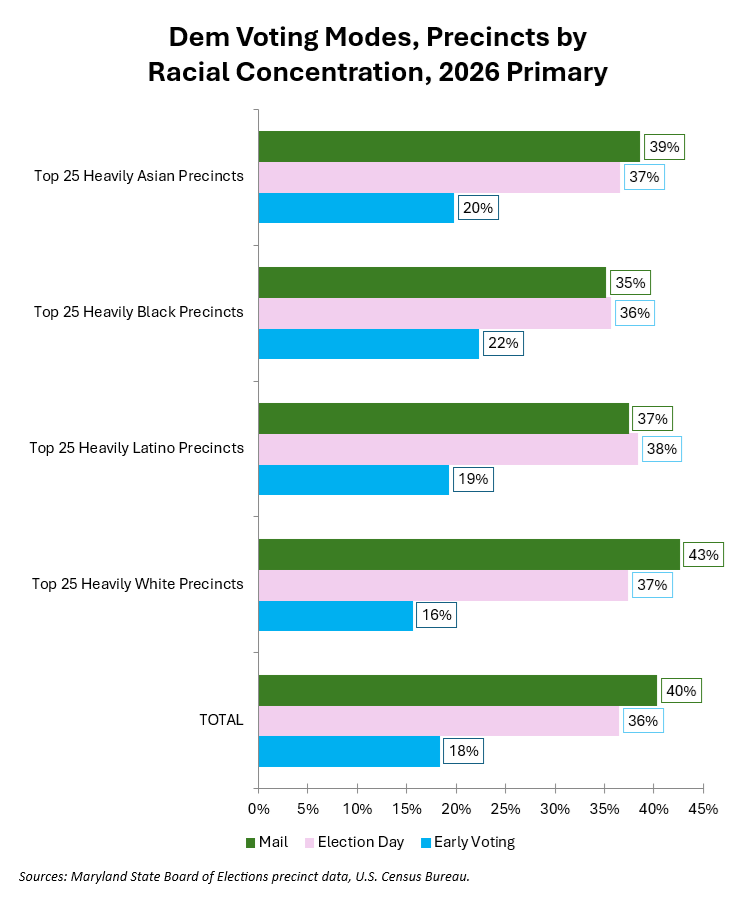
The differences by racial group are not huge. White precincts show a bit more mail voting and a bit less early voting. The opposite applies to Black precincts.
I crunched voting modes by local area. One thing that stood out is that areas containing early voting centers tend to have higher rates of early voting. Surprise, right? Other differences were not great.
Here is one thing that did seem to matter. In the five precincts that contained MoCo’s three largest retirement communities (Leisure World, Asbury and Riderwood), 62% of Dem voters voted by mail. In all the other precincts, 40% voted by mail. That suggests that seniors may prefer to vote by mail, and since seniors tend to have high turnout rates, that amplifies the importance of mail voting.
When I ran correlation coefficients between voting modes, racial distribution, mean household income and turnout rates, almost none of them were bigger than +/- 0.50, indicating that those factors didn’t matter very much. The sole exception was the correlation coefficient between mail voting in the 2022 Dem primary and mail voting in the 2026 Dem primary. That stat was +0.63, a moderate-to-strong positive relationship. This suggests that voters who become comfortable with voting by mail tend to continue to vote by mail. An astute campaign manager would consider targeting early comms specifically at mail voters to maximize expenditure efficiency.
That’s it for turnout. We will get to individual races next!