
By Adam Pagnucco.
Part One listed Will Jawando’s assets and liabilities. Part Two looked at Andrew Friedson. Part Three examined Evan Glass. Part Four recited a timeline of key events in the election cycle. Parts Five and Six broke down Jawando’s performance. Parts Seven and Eight looked at Friedson’s performance. Part Nine reviewed Glass’s performance. Part Ten examined the degree to which council at-large election results are a valid predictor of county executive elections.
We conclude with three final thoughts on this primary.
County executive elections are closer than they used to be.
Check out the table below, which shows margins of victory in MoCo county executive Democratic primaries since 1978. (Prior to then, the county’s first two executive elections were won by Republican James Gleason.)
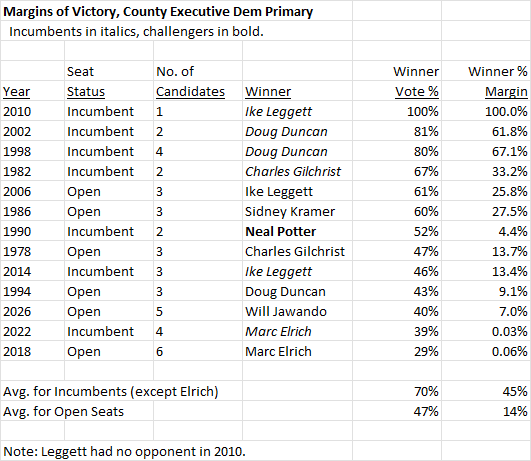
The last three primaries, featuring wins by Jawando and Marc Elrich, are three of the four closest in the series. Neither of the Jawando or Elrich victories touched the huge open seat victories of Sidney Kramer in 1986 (28 points over David Scull) or Ike Leggett in 2006 (26 points over Steve Silverman). Furthermore, no executive candidate has earned a majority vote in the primary since Leggett ran unopposed in 2010. So there should be no talk of mandates but rather acknowledgement of a divided Dem primary electorate.
Would ranked choice voting have changed the outcome?
More than three years ago, I wrote a series on ranked choice voting (RCV) in which I examined the results of 1,120 RCV-eligible elections across the United States. (I’m not aware of anyone else on either side of the RCV debate publishing an analysis of comparable detail.) At that time, RCV changed the election outcomes only 2% of the time. So I’m skeptical that RCV makes much of a difference in elections for better or worse.
Second, when RCV did change a result, it was most likely to do so when the first round ballot leader earned less than 35% of the vote and/or had a margin in low single digits. In our primary, Jawando received 40% of the vote and led Friedson by 7 points. Jawando does not look particularly vulnerable to a changed outcome.
Now let’s examine our primary specifically. The combined votes of Mithun Banerjee (2.28%) and Peter James (1.60%) would not have amounted to enough to put any candidate above 50%. That leaves Glass, who received 22% of the vote, which would have been more than enough to potentially tilt the election to Friedson. However, if we are to believe that might happen, we must possess substantial evidence that Glass voters would have mostly picked Friedson as their second choice. In evaluating that possibility, consider these facts.
1. Glass finished second in the heavily Black precincts that gave a majority to Jawando. That suggests an alignment between Glass voters and Jawando, not Friedson.
2. Many of Glass’s best performances occurred in some of Jawando’s strongest areas, such as State Legislative District 20, Downtown Silver Spring and Takoma Park. Again, that suggests alignment with Jawando, not Friedson.
3. Glass’s precinct performance had a -0.31 correlation coefficient with Friedson and a -0.10 correlation coefficient with Jawando. Both of these correlations are weak, but for what it’s worth, there was more of an inverse relationship with Friedson than Jawando.
Accordingly, I find no persuasive evidence that Glass voters would have mostly picked Friedson as a second choice if given a chance under RCV. In fact, there is more evidence that they would have picked Jawando. I think Jawando would have won if RCV were in place and his margin of victory may have been even larger than it was.
Don’t write off Friedson or Glass for the future.
There is a temptation to dismiss losing candidates as washed up. That would be a mistake in the cases of Friedson and Glass. First, Jawando lost his first two elections (District 20 Delegate in 2014 and U.S. House District 8 in 2016) but that did not stop him from claiming the second floor this year. Second, Glass lost his first council election in 2014 (a one point loss to Tom Hucker) but he won his next two elections, including a first place at-large finish in 2022. Finally, MoCo political history is full of candidates who lose and come back to win, including outgoing County Executive Marc Elrich, who lost his first four council races.
Friedson and Glass are capable politicians with big networks who are still fairly young. I wouldn’t be surprised if either of them stays in the mix and runs again someday. Nor would I be surprised to see them work their way back to the top of MoCo politics. So when they call you, answer the phone. You may someday regret not picking it up.
That’s it for the executive race. Coming up: county council at-large.